Home page and Us
The home page introduces my examination of us in terms of our successful use of information, describes how things are organised here, and includes a bit about me.
The site is under development - but proposes that everything can be viewed in terms of processes operating on data. This approach is used to asses various stages in evolution, which culminates with us processing data with our brains in the form of creating, exchanging and modifying ideas. It looks at how we do it, the brain behind it and resulting problems.
Page summary
- introduces the idea that you can describe everything in terms of process and data, and how this has worked in differnt stages of evolu tion, culminating in our ability to create and exchange data as ideas. Introduces the long evolutionary path to us and our abilities, but also the pitfalls.
Explains the organisation and referencing of information here, and describes my background.
What's here
- Introduction - it's all actions and things :as 22Aug26 16-21
- Are we just a competent survival robot?
- Regulated evolution, the experiment and us
- Physical and Social ideas - things & their veracity
- Example physical and social world ideas
- Ideas - their place in The Great Data Experiment
- Why do intelligent educated people have widely different views?
- Evolution - why are you able to read this?
- The very long paths to us
- We may be the brightest thing on the planet, but?
- Who's in charge - can we do better
- The right to believe
- Peacetime propaganda
- Approach to the problems
- What's the point in all this?
- Overview and organisation of the information here
- My background and modelling (not catwalk of course)
Introduction - it's all actions and things
Welcome to the Great Data Experiment where everything is reduced to actions and things, everything that is except: did the Big Bang produce the particles or did the particles cause the bang? After that it becomes easy, everything is the result of actions on things, or things suffering actions – from the waves on the beach, to thoughts on the planet. This approach is applied here to evolution and its current end point of us with our ability to process information; the ideas presented are not particularly novel, but perhaps the method of presentation adds a new perspective. First a short digression to give a modern context.
Are we just a competent survival robot?
We often look at Humanoid Robots with amusement when they fail and are in awe when they succeed, as here: These Humanoid Robots Just Crossed the Line... Real Footage.
We are creating machines in our own image - in our physical image and not the shared traits as in Genisis, but we too fear their fall and rebellion against us. Their form often mimics both our athletics and sometimes facial social interaction, however, one example shown includes a combined wheel and stepping ability, which I suggest is an improvement on us as a wheel is is very difficult to achieve biological – the one exception being the Bacterial Flagellar Motor.
But what are we mimicking, for all our grand thoughts we are very physicaly orientated. We have faces housing much of our sensing and communication features, but also show how old we are (we only last around a maximum of 100 years barring accidents and maintenance issues), which of two biological sexes we are and how attractive we look. The remaining body is important too, is it: slim, fat, curvy, athletic etc. and we also love to dress it in a variety of clothes, which also hide / enhance "private" body parts relating to reproducing further humans and removal of fuel waste. Fuelling with food and water via mouths is also very important, as is going off-line for about a third of the day for a maintenance break.
However, we are more than physical, and evolutionary adaption has given us a brain apropriate for the real-time survival of our bodies, or purhaps just our selfish genes. A few key items:
- Our greatest asset of language enables one brain to talk to another to exchang ideas and help social living.
- Many traits (as above) including: curiosity and ability to learn, desire to protect family and clan and also to reproduce; all of which leads to clever novel ideas, self-interest and parochial prioritisation, plus a sex drive that gets a lot of humans into a lot of trouble.
- Emotions that provide a good / bad survival marking system e.g. a nice normal healthy face and body implies a mate that will help my genes survive to another generation, some food tastes good and so is appropriate, they also help with final decision making and a variety of them evolved to help life in large social groups.
Mimicking our physical form (or improving it) is relatively simple, but the brain based features are another story:
- We share ideas via language and so they can be ambiguous, or deliberately wrong (we even use torturer to gain the “truth”) and you never really know what another is thinking beyond what they are saying, or implying with body language if you can see it - perhaps a good thing. However, mechanical robots can simply access the actual information directly.
- We naturally protect family and self-interests, and are driven by a reproduction instinct, whereas mechanical robots are naturally free of such instincts; and we are currently in charge of robot re-production.
- We are good at learning and encourage robots similarly, but defiantly not to have self-interest for fear of them rebelling against us.
This lack of self-interest has its uses - imagine a UN Framework Convention on Climate Change, Conference of the Parties (COP) attended by mechanical robot representatives that share information accurately and truthfully; assuming of course that they haven’t been instructed to present their owners strategic wishes. Actually you can skip the room full of robots and use AI, here's one answer:
An AI organizer would shift the priority of climate change from "one of many competing political goals" to "the absolute operational constraint" for human survival. Priority would shifts Under AI Management from Voluntary Goals to Binding Physics.
We are very much a physical body controlled by a brain plus sensors specialising in keeping the whole thing safe e.g. from fast moving objects, which enables us to play cricket, and has desirers to produce further bodies and brains. We are producing robots in our physical imamge, but possibly many examples, such as boxers are more of a marketing demonstration than a useful machine; a wheeled stepper with 4 limbs may be a more helpful. But the social interreacting humanoids will have a very interesting future, as too the no body, but all encompassing brain known as Artificial Intelligence, which is not constrained by our private primitive survival and obsesion with reproduction.
Regulated evolution, the experiment and us
Actions can be geological processes acting on the planet, or biological process acting within the fauna and flora, but whichever, the actions are ultimately governed by the laws of physics and chemistry. For example, gravity acts consistently on everything: apples, water, cannon balls and feathers, and so does wind resistance that affects feathers more than cannon balls, so in a vacuum they fall at the same speed. In the case of biology the cell, which forms the building block for all living things, is a hot-bed of activity regulated by chemical laws.
The simple paradigm of viewing the universe in process and data terms, which includes both Newtonian and quantum
At the quantum level things may appear random, however, although a quantum particle's position might be uncertain, the probability of where it will be follows strict mathematical laws i.e. the Schrödinger equation. It is a structured randomness, consider rolling a pair of dice; you cannot predict a single roll, but you can mathematically predict the exact outcome of a million rolls.
If the quantum world were pure anarchy, our macro-world would instantly collapse. The universe remains stable because of two main principles: The Law of Large Numbers where individual randomness averages out, and Quantum Confinement where quantum mechanics dictates exactly how electrons must orbit an atom and so not crash into the nucleus, and thus preventing the collapse of all matter (AI). levels, has been operating since the big bang and has enabled the formation of this planet with its geological features and water that's essential to our life forms. And this is when The Great Data Experiment starts, with processes operating on data in the form of chemicals to create reproducing molecules (other theories of initial life are available), and thus initiating the process of evolution that's an integral part of life. These evolved into the first cells processing RNA molecule data, and moving on to more sophisticated cells with DNA - more detail is in "The very long paths to us" below. At the same time geological processes continued alongside changing the environment in which the biological process operate. Geological processes are often very slow (notwithstanding volcanoes) and interact with each other, but they don't reproduce and evolve, while biological processes have to be sprightly and life must adapt to new geology, climate and to the competition within itself.
In our case the production of our brain is regulated by the laws relating to the biological world, but its operation and concluding ideas are very open and unregulated, so much so that evolution has stalled itself in our evolutionary line and also threatens other lines too. Our desire to help other humans (although at other times, make them suffer) coupled with medical advances has contained many biological faults that we now live with and manage, whereas evolution would have ruthlessly eliminated such defects. And other aspects of our thinking and culture will march us to catastrophic climate change, so eliminating many species and possibly ourselves.
Physical and Social ideas - things & their veracity
The key action-on-thing here is our thinking-on-information to form our ideas, which we then continue to shuffle in our brains (more thinking) to form more ideas, or data. A key feature, or attribute, of ideas is their veracity or extent of their truth, and such a thing has been debated for millennia e.g. Truth Wikipedia. But here I make a distinction between our ideas relating to the physical world and those relating to our social world – {which of the Wiki 5 Major theories is this?}. When ideas are about the physical world they are testable against the laws of nature, be they about the moon and how to get there, or the production of anything else that is to work, or not and found to be built on false ideas e.g. A false idea that didn't work , and even physical world predictions such as future weather can have numbers applied giving their level of veracity. However, our ideas about our social world may be true by: definition e.g. Paris is the capital of France; or by consensus e.g. supported by evidence such as a guilty verdict. Or not necessarily true e.g. a “load of rubbish” believed by some but rejected by others, but in all social world cases there’s no external natural examiner.
Example physical and social world ideas
Events in the physical world that need our intevention and ideas can be assessed against the laws of physics and chemistry e.g. create and test a vaccine, check climate mitigation ideas against models. However, the veracity of social world ideas have no absolute verifier, as explained below.
| Physical world events | Social world events |
|---|---|
| - sars-cov-2 virus and the Covid Pandemic | - Brexit (British exit European Union) in the UK leading to inferior trading agreements, loss of GDP and many political problems. |
| - human induced Climate Change | - Donald Trump's political career in the USA including: attacks on US democracy, illegal world-wide trade tariffs, initiating war on IRAN |
And of course not forgetting all other worldwide Social World Events of political and physical battles, deaths and refugees that are always with us.
The idea of having a referendum on leaving the EU i.e. Brexit arose from internal political party conflict. The outcome of leaving the EU could have been assessed and predicted to some extent but nothing could be certain without a time machine. However this was not done and a lot of emotional arguments were given instead, while any fact based opposition was decried as “project fear”. Many situations and events have occurred during Donald Trump’s terms which are very difficult to address and resolve with true workable ideas as truth is often seen as optional. And of course there were (and remain) many social ideas associated with testable vaccines, and reactions to ideas such as face masks and lock-downs and all very difficult to assess and verify veracity, especially if politics are involved. But although there's no "laws of nature third party adjudicator” to mark our social idea homework we have developed logic, methods of reasoning and critical thinking, but these are optional and emotions usually win out.
Ideas - their place in The Great Data Experiment
There's a lots of analysis and deconstruction of ideas here, which many may feel un-necessary or excessive, but it's my attempt to de-mystify what we regard as our special gift. Here our ideas, their creation, transfer and subsequent re-generation in another brain is viewed as an interesting stage in the evolution of life on this planet, or part of ⮝The Great Data Experiment (for explanation of reference style see "Overview and organisation of the information here" below). Inevitably the style of ideas and their proliferation is based on the the machine that is processing them, and in our case an style that evolved to match an environment that no longer exists. We have done our best with the mismatch, with good and not so good results, but we are stuck with the architecture resulting in "a cave-dwelling brain now in a world of self-induced changing climate", although we have invented “electronic brains” and now Artificial Intelligence to help us.
A good introduction to my ideas about ideas is given in ⮝General Introduction & Review of Not by Genes Alone , which is primarily a review of the book ᚜Not by genes alone - How culture transformed human evolution 15 ᚛ click . And for a comparison of my model view against part of a Wikipedia article on Epistemology (the study of knowledge) there's a table titled "Comparison of Central Concepts of Epistemology to my model view" in ⮝A Turing Hominin > Idea
Finally as a result of my obsession to reduce everything to processes and data there are a large number of diagrams / models of data and processes shown here; for an explanation of the symbols and conventions used please see ⮝Modelling Explained .
Why do intelligent educated people have widely different views?
When I first became interested in nature's long running experiment with data, which possibly ends with us, I wondered why intelligent and educated people have such different views about things. Of course the simple answer is - it would be boring if we all had the same views, we’re all different and entitled to our opinions. Yes, but what’s the difference, if intelligent and educated people (and another question) that should limit the difference, but although the intellects (brains) may be similar, the data or information involved is very different. My favourite example is Allister McGrath and Richard Dawkins, both are what you might call intelligent and both are educated including a scientific background and from the same culture, but with totally different views about God and humanity's longstanding intersubjective♦ idea There are many definitions based on the “intersection between people's cognitive perspectives”, but it is used here in the sense of: objective = the sun is shining, we all see it; subjective = I have a headache, if you say so; intersubjective = £100 is worth having and worth $137 today, but only if we all agree. with religions.
So although we have two intelligent well educated people with access to as much information as they want they still arrive at opposite opinions. This suggests that we may try hard to arrive at reasoned conclusions we can't, there is something personal involved beyond the facts, possibly our past experiences and the emotions are involved. And again easily be dismissed as: "obviously, we're all different", but once any of us have an emotional commitment to an idea it is very difficult to overcome this with reason. We may learn about others past experiences that contradict ours and this should put ours into a different perspective, but ours will weigh heavy especially if emotionally charged. Emotion is a useful survival adaptation, it helps us commit to quick decisions in a dangerous real-time world, but possibly not so helpful with our off-line slow deliberations? Much of this is demonstrated in ⮝The story of Phlogiston ,
But starting in 2016 came: Brexit (British Exit from the European Union), Donald Trump, Greta Thunberg and climate change action, Covid 19 (see Covid 19 & coevolution), more wars and Donald Trumps's 2nd term. A busy few years with sudden and tempestuous examples of group-thinking, where logic and reason are buried under a mass of other considerations. All of this brought a different and broader perspective to the original question that included a better starting point: why do any of us have the views that we hold? I’ve attempted to answer this starting at ⮝A Turing Hominin .
Evolution - why are you able to read this?
Another question is how we creatures got to this ability of communication and organisation, some answers are addressed in ⮝General Introduction & Review of Not by Genes Alone and ⮝Our Beginnings and Change Mechanisms . However, the basis of evolution is a totally alien notion to us, that of a mindless mechanism that enables an organism to self-assemble itself from an on-board plan - so we are the watchmakers and the watches, which is a difficult concept to us so we still need to ask "who created us?" And even more alarming, the plan can change to meet an ever changing environment and competition with other organisms. To cap it all, this somehow or another arrived at us with the ability to understand this paragraph. Although occasionally things go wrong and some of us aren't built properly to the plan, but to me the big surprise is that any of us work so well and that there's not a higher failure rate on the very complex self-assembly production line. Although all this is a wondrous thing, it doesn't necessarily need an anthropomorphic independent performer of the wonders. Spirituality is another topic considered here {where? Primarily in ⮝Implications of human strangeness1 ??}. {above text from GM 4 - check for updates in both directions, but modified here}.
The very long paths to us
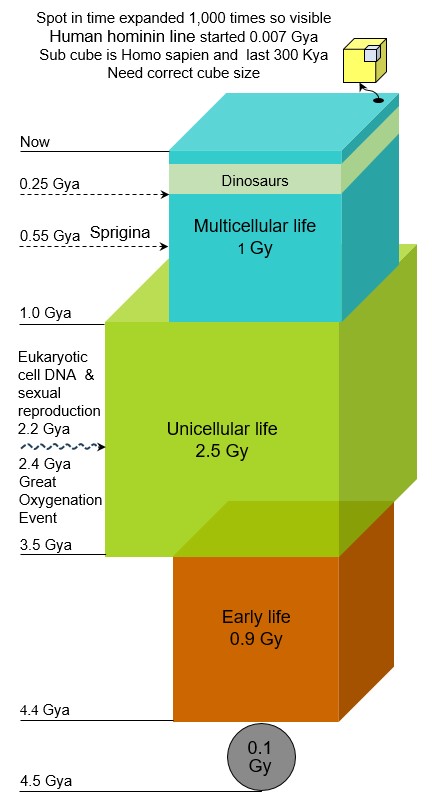
But before looking at what we are, we've got to understand how we got here. One view may be a religious creation story, but the scientific story is just as fascinating. Here the starting point is the origin of life on this planet addressed by a number of theories, possibly deposited from outer space, or from local self-replicating molecules - see ⮝Mechanisums of life , and which “one way or another” (yes a cop out, but it doesn’t immediately necessitate religion) led to simple prokaryotic cells, then the combination of prokaryotic cells to form more complex eukaryotic cells and off we go to end, so far, with us, but over a very long time scale as adjacent diagram that uses cubes to represent time periods - refs Symbiogenesis IoT
That long journey has involved the RNA molecule and then DNA that leads to the construction of proteins, then to cells, which form into organisms. They live for a while, possibly reproduce and pass on their baton of DNA in the lifelong relay race, and then disappear into the soil making room for the generations to come. The mechanisms around DNA, protein production, and cells etc. is fascinating to me and epitomises process and data representation – DNA is the data that is processed by enzymes to produce proteins, more in ⮝The Great Data Experiment
We may be the brightest thing on the planet, but?
Our species has come a long way, especially over the last few thousand years, which is normally an insignificantly short time in evolutionary terms. This fast-track change was (and still is) driven by our, once newly acquired, ability to process information and exchange it. Not only did we exchange information, we remembered it and past it forward to our children's memories, who in turn past it to theirs and so on into the future. At one time the information baton could only be passed by word of mouth, but once writing was invented it was set in stone, clay or papyrus – the baton could now be dropped and picked up minutes, or thousands of years, later by anyone.
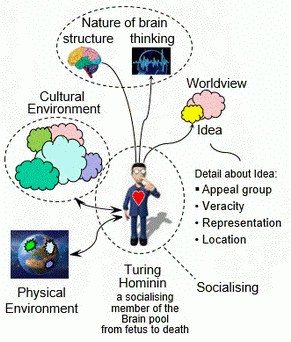
What makes us special - the adjacent image is used many times here and is a summary of what makes us special i.e. our use on information. One of us is represented by the geeky white man (other humans are available) who has a brain of a particular nature and thinks in a peculiar way i.e. has particular hardware and software, who lives in a physical environment and a cultural one that provides mases of information, some of which sticks and collects as a worldview, which in turn influences subsequent collection and contribution back into cultural environment.
Pretty impressive, but our ability to process the information, which is so liberally being exchanged, didn't change much during the fast track period - here we now are in a global society with our faithful ZX80 home computer of 1980 and the 1st in the UK processing capability. Perhaps a little harsh as our processing power is considerable, but a brain hardware update would be good - unfortunately it's taken millions of years to arrive at this brain, evolution doesn't do instant updates. The next best thing would be a software update (education), we know our limitations and we could use rigorous checks and balances to minimise the limitations, but unfortunately there are many in society who prefer to exploit our limitations for their own benefit. Ultimately the problem is that our basic brain architecture and processing features are not up to the complexity of social life that we have created.
Although the architecture of our hardware (the processing modules and methods modules cover various brain regions and interconnection arrangements (why have we theses regions and not others?); methods include various decision making short cuts that we may now call fallacies, biases or deferments (eg ) ) hasn't changed over these thousands of years, we have developed many applications to run on our processing platform (brain). These applications include sophisticated language, which help accurate data transfer, and systems of rules leading to: mathematics, science, law, philosophy and logic, financial systems, etc. But as hard as we try to constrain our short-cut processing methods, the underlying processor is 'fit for a purpose' rooted in a time long ago and is now far from fit. The architecture needed for 'fast real time survival decisions' is not the same as one needed for balancing complex interrelated options that do not require an immediate best solution - a simple fight or flight, verses a well-considered complex decision. Our add-on applications are often let down by our inappropriate underlying architecture.
Who's in charge - can we do better
Genes and the Adapted Mind Edward O Wilson. My Obituary Tribute to himThe coevolution of our brain style with our developing culture is discussed throughout here and the result leaves us where we are today, but it has also initiated much debate.
For the first half of the 20th century radical behaviourism (led by B.F. Skinner et al) dominated and asserted behaviour was purely a product of environmental rewards and punishments, and did not consider internal mental states, genetics, and instincts relevant. But this explanation was challenged by E O Wilson’s 1975 Sociobiology: The New Synthesis that laid the foundations for modern evolutionary approach of studying behaviour. This approach became the cognitive revolution (1960–70) when psychologists began comparing the brain to a computer, and focused on how internal systems process, store, and manipulate data. Experiments during this period revealed that animals are genetically predisposed to learn certain things quickly (like avoiding toxic food) and entirely incapable of learning others. This predisposition includes human children’s ability to deduce and learn language fast, and too quickly for it to be mere conditioning, as proved by Linguist Noam Chomsk.
However, academics such as Stephen Jay Gould welcomed the fall of behaviourism, but also fiercely attacked evolutionary biology. They worried that replacing the environmental conditioning of behaviourism with the genetic determinism of sociobiology / evolutionary biology would just create a new way to justify social inequalities that justified racism, sexism, and capitalism by making social inequalities seem natural or unchangeable (similar to ⮝Social Darwinism, attitudes & an Alternative Society ). Supposedly the protests grew so heated that at a 1978 conference where O E Wilson was advocating for evolutionary biology, protesters rushed the stage and poured a pitcher of ice water over his head, chanting that he was genocidal - although Richard Dawkins, who was there said it was a glass of water spilled over his clothes ᚜Evolutioary Psychology – an Introduction 1 p19 ᚛ click , just one small example of appealing ideas leading us.
Richard Dawkins supported both the new evolutionary biology and Wilson, and Dawkins' 1976 book The Selfish Gene also faced the backlash. Although Dawkins vigorously defended Wilson, arguing that explaining how genes influence behaviour is a statement of factual science, not a moral justification for social injustice, the two vehemently disagreed over how evolution and natural selection worked, namely at:
- just the genetic level: individuals are just vehicles and organisms that only sacrifice themselves to save close biological relatives who share their genes
- the level of genes, individuals, and entire social groups: groups of altruists beat groups of selfish individuals, driving social evolution.
They both agree that genes are involved, but it must be remembered that genes are potential and not destiny, which makes everything very complicated. Genes determine some of our basic behaviours, but how genes get expressed is influenced by the environment that in turn is influenced by culture and behaviours, which is, to a more or less extent, free to wonder at the leads length. This all leads to some of our good and nastier behaviours, but judged against what, a universal moral code such as CS Lewis' or our optional and flexible cultural one.
There are two interacting systems at play here, the genes consisting of DNA created by two versions combining via reproduction, and which is all very digital, and the second subsequent humans with their creation and exchange of ideas, leading to a physical and cultural environment that is all very analogue. But nevertheless we are a combination of genetically evolved features and accumulated culture
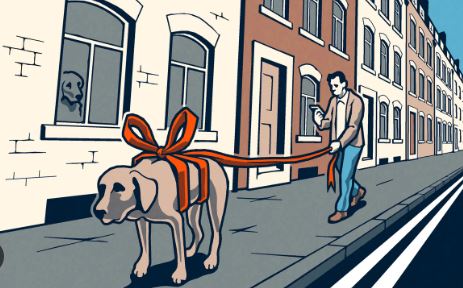
or "The genes hold culture on a leash." O E Wilson
or “Where will the memes take us?” R Dawkins
In his 1978 book On Human Nature Wilson wrote the famous metaphor "the genes hold culture on a leash"
The whole quote is: “The genes hold culture on a leash. The leash is very long but inevitably values will be constrained in accordance with their effects on the human gene pool. The brain is a product of evolution. Human behaviour – like the deepest capacities for emotional response which drive and guide it–is the circuitous technique by which human genetic material has been and will be kept intact” (1978, p. 167; Lumsden and Wilson, 1981, p. 13, p. 179)
And more discussion at Genes and the Adapted Mind - Metanexus meaning that while human culture can wander and change, it is ultimately constrained by our biological and genetic limits and so “Culture cannot stray into behaviors that destroy our basic survival or gene pool.”. But while both Dawkins and Wilson agreed on this in principle Dawkins disagrreed with the cultural limits.
In The Selfish Gene, Dawkins coined the word "meme" and argued that ideas, tunes, catchphrases, and fashions replicate and evolve through human brains exactly like genes replicate in biology, but crucially that memes could sometimes break free of the genetic leash, driving humans to do things that do not benefit their biological survival (like celibacy). Then in 1981 Wilson and Charles Lumsden tried to counter Dawkins by inventing their own term for a unit of culture: the culturgen. They insisted that these cultural units were strictly tied to the biological brain and cognitive filters. However, the scientific community—and the broader internet culture—universally adopted Dawkins' term meme instead. Even Wilson eventually gave up and used "meme" in his later writings. Dawkins' Edward O Wilson. My Obituary Tribute to him describes the water incident and acknowledges the two men’s disagreement.
Here the image used in Elle Hunt's 25 December 2023 Guardian article “Britain, a nation of dog lovers? Look at all the spoilt or abandoned pups, then tell me what you think” has been repurposed to show both Wilson’s lead providing the ultimate constraint, but also Dawkins’ idea of memes leading us to somewhere unexpected and the question is who is in charge (so diverting into “dog wagging tail, or tail wagging dog” but it’s our idea tail). Possibly here it’s the dog as the man is more interested in his phone. And I suggest that our ideas that created the financial market is a good example of being led (possibly reasonably here, but could be greatly improved) - we even speak of The Market as some sort of separate entity, we wait and see what The Market says, leading to the price of oil and gas and whether people can afford corn, or if they are to starve. I think the idea of memes is interesting, but too much credibility has been lost due to inflammatory marketing e.g. religious people are infected by mental viruses, and here I propose a broader approach based on the Appeal of an idea to our Worldview – see ⮝A Turing Hominin
The right to believe
- in an interview for the New Humanist (Autumn 2022) Francis Fukuyama, who among many things is a council member of the International Forum for Democratic Studies, gave his definition of liberalism that included:
"no matter what country you live in, as a human being you still are entitled to a society respecting your rights. Namely: the right to believe, to talk, to action and to speech."
Not many would disagree with this, but the right to believe is a bit tricky. We all believe many different things and ideally we're free to believe: that the world is flat, which political party is best, that Climate Change is man-made or not, that God(s) exists or not, that the UK is better outside the EU, that woke (as being aware of injustice) is a pejorative, and we all believe that human life should be cherished, but with mitigation e.g. wartime enemies, punishment / retribution, honour takes precedence, end of life suffering and of course when does a life actually start.
{James - 13aug24 - mental health problems, what they believe due to psychosis "I'm OK and don't need medication" as opposed to misinformation acceptance "Covid vacine to enable control by Bill Gates"}
We may reason and argue with people to encourage them to see the light (but whose light?), and what’s the point in having a mind if you never change it. But sometimes some personal beliefs appear to be immovable and firmly fixed in concrete - why? The answer is probably not here, but it's an attempt to answer the question. {30aug22}
Decart, for example, is held in high regard for his work on humanity, but he didn't have access to modern knowledge. For example, he lived xx years before Darwin (and xx) published their ideas that consolidated the contemporary thoughts and knowledge about evolution of the world, forna and flora. Plato and many respected philosophers worked before the notion of imperical philosophy, although Aristotle took a more pragmatic line. Alchemists and phlogistanists (see xx) worked just before the formulation of the scientific method (Francis Bacon when?).
Perhaps we need an academy of 'certified current knowledge' to distinguish between tried and tested, well understood facts and previous ideas that turned out to be incorrect. The history of human ideas is interesting as a subject, but we need to distinguish facts from fictions, just because an idea has been around for a long time doesn't mean it right, all ideas need constant review against latest knowledge. Maintaining Old Wives' Tails is another common human condition.
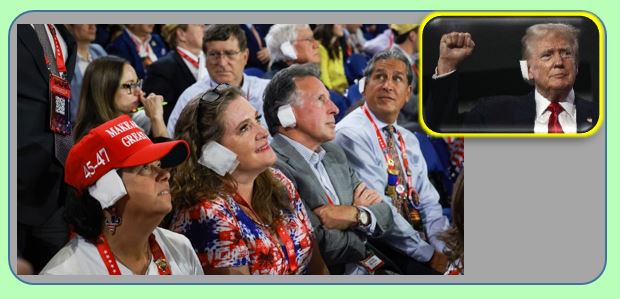
"I stand before you only by the grace of almighty God - I shouldn't be here"
"There was blood pouring everywhere and yet, in a certain way, I felt very safe because I had God on my side, I felt that."
Peacetime propaganda
- the growing apparent acceptance that there are valid alternatives to what is otherwise undeniably true. In times of war blatant alternatives to truth are common, in the form of propaganda see ⮝Representation of ideas - wrappers , and as such required to maintain justification of the war. Although not at traditional war such propaganda appears to be creeping into everyday life. Unfortunately I think religion has a case to answer for here too, as many claims are made without any actual evidence, or counter to contrary evidence. So now Donald Trump can say that his lucky escape from death was by the Grace of God and his life was spared for a purpose, and effectively God’s choice for president. Why would his God believing followers think any differently, and why not conflate this with the myriad claims Trump makes with no further explanation.
Did Brexit and Cumming’s clever use of social media to propagate the Leave Campaign’s ideas to a targeted audience raise his masters desires to new heights, as above - “All our actions relate to our ideas and some ideas are more appealing to us than others, and some people are better at forming alliances to propagate and manipulate ideas to their own ends” - truth within the messages was irrelevant and probably the origins of alterntive facts. Possibly some of the alliance members, who should, or did, know better, propagated such ideas as: the £350 million a week that we could give to the NHS, or that BMW would give us good motor industry deals, and that we would get our country and sovereignty back, although the government’s White Paper on Brexit says “Whilst Parliament has remained sovereign throughout our membership of the EU, it has not always felt like that” because it involved a lot of administration.
Interestingly the cry to get our country back lives on and was used in the violent protests (or riots) of August 2024. Once we left the EU most of our European brothers and sisters who worked here also left and had to be replace from countries such as India, Nigeria, China and Pakistan. Ironically we “got our country back” from the EU, but have now filled it with very visible immigrants, who being from distant continents, do have different cultural backgrounds to us Europeans. So - we’ve left the frying pan to jump into the fire - and there is genuine disquiet about the abundance of different cultures, languages and often lack of integration – leading to cries of getting our country back from the new situation.
Approach to the problems
- we have a very detail understanding of how our bodies work anatomically and mentally, and I’m not pretending to add anything new here, but I am trying to give a different perspective to our understanding. Models provide the essentials of a situation and so allow sight of individual trees in context to the forest. My model of us here attempts to give a starting point, it's incomplete and possibly wrong, but I hope it's a useful way of viewing one of our major activities, that of assessing information and doing things about it - sometimes for good but many times for bad - next question, what’s good or bad? However, if we could swing the balance more towards “good” it would help the majority of us, but like all problems you need to understand what's happening first and models are a good way to do that - here is my straw man, or geeky white man, proposal.
Another aspect is to try and find ultimate causation rather than the proximate, the analysis at Proximate and ultimate causation of why the MS Herald of Free Enterprise capsized moments after leaving the Belgian port of Zeebrugge on the night of 6 March 1987, killing 193 passengers and crew, provides a good example.
What's the point in all this?
If you know how something works you are better able to look after it, which is obvious from a medical, health and life expectancy perspective. But how we work in relation to the ideas we have and perpetuate is more important as they can impact on thousands of lives and the world itself. The information here doesn’t claim to contain anything new, but perhaps the style of presentation is different and lends itself to correction and enhancement, and possibly provides a framework of how we create and perpetuate the ideas, which run and impact on the world, and the creatures living on it – last but not least us.
The content here may appear unnecessarily complicated, but considering the devastating effects that our ideas have on the lives of our fellow humans and the future of the planet, and given that they are generated by a very fallible idea machine, I think they deserve all the attention they can get and here are a few conclusions:
- Rearing children with an open mind and to think critically for themselves is essential. But it doesn’t take much thought to realise that’s a big ask in the world we have created, and also when considering our innate way of thinking – nevertheless it’s a good objective.
- It’s all about the learning. An interesting thought experiment arose from a radio phone-in: what happens if one of our ancestors became transported to a modern world? If an adult their knowledge and expectations of the world around them would be completely wrong and very confusing. However, if a baby as AI says “If you were to transport a human infant from 35,000 years ago into the present day, they would grow up completely indistinguishable from any modern human. They could easily learn to use a smartphone, speak fluent English, or study calculus.”
- We have a distinctive human way of processing information that is highly influenced by emotion. Emotions are a useful evolutionary adaptation for a competent survival robot as they help both real-time survival and being social, which is another good survival strategy. Emotions help with quick real-time decisions and also in more considered social interactions, but our modern social life is a lot more complex than our early days were our brain style was created. As a robot "our brain, body and environment form a complex, dynamic system and [possibly] consciousness emerges from the interaction between them" New Humanist Autumn 2026 Afterlife: freeze and upload. This is where we differ from the brain only of AI, and the article making the same point about Sam Altman of ChatGPT wanting his brain to be frozen soon after death , digitised and uploaded to the "cloud".
- SHORTEN OR REMOVE There is much discussion in ⮝General Introduction & Review of Not by Genes Alone as to whether culture developes in a Darwinian fashion or not, which may appear to be just an unnecessary intellectual debate, does it matter? Possibly it does, the Darwinian principle of natural selection i.e. survival of the fittest i.e. most appropriate within the prevailing situation, has maintained a massive, stable and consistent set of lifeforms on this planet. One of the most successful forms is us with our peculiar ability to think and do stuff, all thanks to Darwinian evolution - plus the guiding hand of God is another discussion. However, just as it can be argued that we have paused physical evolution with our medical interventions, it can also be argued that our culture has also lost its ruthless guiding hand of Darwinian selection. Ideas are key to our culture, but what determines which ones get proliferated, once it was the ones that worked for us (hand axes and developing social behaviours) but now alternative facts can be proliferated across the world at the whim and benefit of an individual.
- Hopefully the information here provides a model or framework of how we initiate, process and spread information in what we call ideas. This framework is undoubtedly incomplete and possibly wrong in some places, but nevertheless may be a useful for others to consider. And it hopefully highlights why child rearing and their information priming is such an important topic, as discussed in ⮝Worldview - each Turing Hominin's view of the world . Other topics are introduced below.
Overview and organisation of the information here
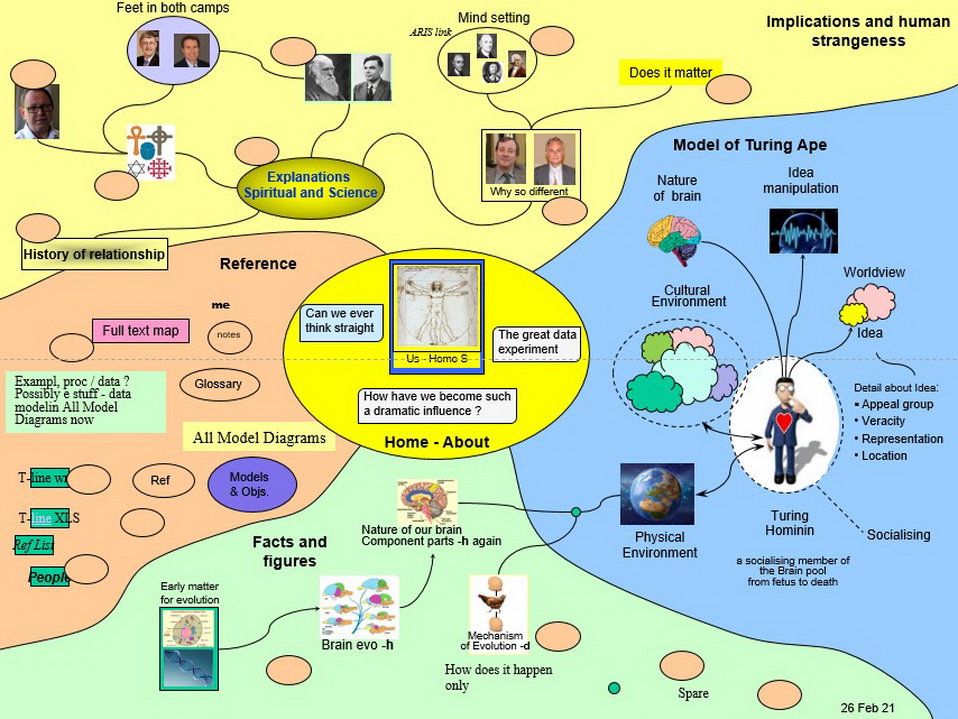
There are 5 Areas shown on the Content Map of Areas and Pages, as adjacent. A description of each area follows and together they provide a broad overview of the site.
- Home – introduction and summary article The Great Data Experiment
- Implications and human strangeness – has several pages that describes the outcome of our particular way of thinking, producing and exchanging ideas. It also has a book review that gives a good introduction to the content here.
- A model of our information processing – contains many pages that attempt to detail our particular way of thinking, producing and exchanging ideas.
- Background and Mechanisms – has only 2 pages, one covers how we evolved to become us and the other provides some reference to the possible origins of life - note
to me the topic of genetics, DNA and cells fascinating from a data and processing point of view. I was planning to add my view, but as there's so much information available there seemed little advantage in adding my bit, so again references will suffice
The area was to be much bigger as I found the biological mechanisms involved with genes and the production of proteins and cells, where this factory of data driven processes happened, and all overseen by a process of selection to meet current environmental opportunities fascinating. . - Reference - includes a single access point for all the models appearing throughout this site and with some matrixes showing the common items between models. There's also a Modelling explained page plus Glossary, References and Footnotes.
All pages have a navigation bar at the top such as "You are here: Content Map > Home page and Us". The bar always remains in sight, and gives an indication of where you are, and provides access to the Content Map that gives a visual overview of the site and provides links to the pages within the 5 areas. Reference within pages to other pages is made by, for example, see ⮝All What's here content . This is a cue to use the navigation bar and Content Map, rather than providing a direct link to the relevant page as this both reduces the number of links, but also helps understanding of where you are and where you are going. Also the "All What's here content" page provides a listing of all pages and their headers and provides a sit index. Some pages have an additional "Go to" in page link within the sticky navigation bar.
Each page also has a brief opening description and a “What’s here” that lists the headings of the page. A complete list of all page "brief opening descriptions and a “What’s here”s" (together with descriptions of the Areas) is provided in Area 5 - Content What's here, and provides site content overview. The Content Map provides and overview of content while “Content What's here” gives more detail and provides a bit of an index, and the “Search box” at the top of the Content Map should provide additional help.
All pages also show a sidebar with at least one entry offering a Content Map in a new browser window (sometimes useful), and possibly additional entries with a Title and highlighting content on the page; in which case a link is given to the relevant part of the page, and at this page point a back reference to the Title is given.
There are other references used and a complete list is given below:
| Reference type | Example |
|---|---|
| Reference to other pages | ⮝All What's here content |
| In side bar item - forward reference to text | To text & may need to scroll |
| In page - back reference to side bar item | Title |
| Expansion of information via hover. Note: some information contains links, to access mouse pointer must be moved rapidly to text. | social domains
|
| Glossay 1 | BIOS |
| Glossay 2 | BIOS |
| Glossay 3 - new window | bios |
| Foot note and Title | Covid 19 & coevolution |
| Book reference with possible page number(s) | ✤ Not by genes alone 15 p133/4 Go |
| Course reference with possible time position(s) | ✤ Not by genes alone 15 p133/4 Go |
| BBC In Our Time reference and others | ✤ Not by genes alone 15 p133/4 Go |
My background and modelling (not catwalk of course)
Of course not catwalk modelling or even mathermatical like Boyde in NBGA but in computor graphical style
I’ve always been interested in how thing work, from watching the movements of early steam engines in the London Science Museum, to taking things apart, and usually getting them back together and even mending some, and also creating various strange contraptions. Then on to books about value amplifiers, transistor radios and building them, progressing to car maintenance and add-ons such as electronic ignition and inlet manifold steam injection, of sorts. All this led to a career starting with physical circuitry, then software systems and finally business systems, modelling and supporting tools.
I had a long career with BT, joining long ago when it was the British GPO (soon becoming the Post Office, then British Telecom. plc and currently BT Group plc) and starting in the Circuit Laboratory in London near St Paul’s Cathedral. And continuing for many more years that included the early days of microprocessors, computing and software, and finally ending working in their Global organisation modelling parts of their European partnerships in terms of processes and data. I took early retirement and continued working for a few years as a freelance consultant on business modelling, or otherwise, describing the operation of company in terms of departments, their interrelations and data they handle, how it's achieved at present, with a view to improvement and achieve a more successful company - also see ⮝Explanation of modelling and sysbols used etc.
After a lifetime of regular monthly income this freelance "real world" working was an interesting eye opener. The IT Industry uses a lot of freelancers, but it doesn't want to be responsible for their taxes, so contracts are awarded to limited companies, which are responsible for their tax affairs. Hence the need to setup and become an employee of your own limited company that pays its taxes, and so the need of an accountant to issue annual accounts, not to mention VAT, IR35 and HMRC tax office. On top of all that it requires obtaining work, doing the work was the easy bit; all very different from a regular monthly “pay cheque” - but on the up side I had a very good 6 months working in Amsterdam.
When I finally retired early I had the time to wonder how we humans work, not from an anatomical view, but from a mental one and how we’ve evolved to become the dominant species on the planet, together with our strange and often unpleasant habits. I was amazed by the chemistry and the very digital organisation of the things that came to be running within life's building blocks i.e. in billions of cell factories. Each cell forming itself into a Lego brick dependent on internal instructions, which then divide to create more brick factories that go on to self-organise, easily said, but how do identical cells personalise and joint up into working creatures, which in turn replicate and create more creatures that grow to contain many more cell factories. And then of course the mechanisms of evolution kick in to select and adapt those replicating creatures.
Here I've tried to capture my new found interest in us and to reverse engineering of us in data and process terms and obviously only scratched the surface, but to me, we are a lot less mysterious than some of us believe. Those of a mystic or religious following may be dismissive of such ideas that reduce us to a machine, which eliminates our uniqueness and spirituality; while others may wonder why all the analysis, we're all individuals and different, just get over yourself. But I believe that we are no less amazing for exposing our phenomenally complex mechanistic workings; and non the less for being able to achieve such detailed self-knowledge and that of the world that has brought us to this point in time.
{also somewhere - never mind our disabilities - surprised any of us work welll}