General Introduction & Review of Not by Genes Alone
This is a short review of ᚜Not by genes alone - How culture transformed human evolution 15 ᚛ click that also provides a good introduction to my ideas here.
Page summary
- a preamble is provide to give context and includes the mechanisms of Darwinian evolution and the period considered by the book, including climate changes. Various process models are used and explained; this also gives a good introduction to the frequently used models, and represents my obsession that most, if not all, things can be described in terms of - actions applied to things. The review follows and discusses if culture did / does evolve Darwinianly and its relevance. It concludes with a comparison of the book to my ideas.
What's here
- Introduction - Darwin & later opportunities :as 13Sep26 19-55
- Background and preamble to Not by Genes Alone
- Evolutionary mechanisums and Not by Genes Alone
- The period considered in Not by Genes Alone
- Some input from Wikipedia
- Climate changes
- Review of Not by Genes Alone
- Survival Cultural Variant - 1st thread
- Socialising Cultural Variant - 2nd thread
- Topics raised
- 1. Maladaptive anomoly
- 2. Language and social cooperation
- 3. Mechanics of Cultural Group selection
- 4. Tribal instincts
- 5. Culture evolves in a Darwinian style
- The first Darwinian thread
- The second Darwinian thread and issues
- But is it Darwinian - does it matter?
- Evolution targeted on bodies - 1,2,3 on a) - The 1st thread.
- Evolution targeted on cultural groups - 3 on b) - The 2nd thread.
- Final thoughts
- Genes and ideas
- Comparison gene to idea
- Types of idea as intro
- Genes and ideas within groups
- Genes and ideas stand alone - my bit
- Idea category table and selection criteria
- Selection & Darwinism, last words
- Back to NBGA
Introduction - Darwin & later opportunities
I first read "Not by genes alone" a long time ago when researching for this, and the book argues that not only did we physically evolve via genes in a Darwinian style, but our culture also evolved Darwinianly. It wasn’t an easy read (at least for me), but since developing my ideas I've re-read it in detail and compared the authors' ideas of a Darwinian cultural evolution against my modelled ideas. This has been very useful and the result forms a good introduction to my ideas as outlined below. Although the book was published 20 years ago the basic arguments still appear to be relevant.
"Not by genes alone" considers the initiation of our cultural and its evolution going back over a period of 2.5 to 3.5 million years, while another book looking at our cultural evolution ᚜Guns, germs and steel - a short history of everybody for the last 13,000 years 10 ᚛ click concentrates on the effects of later environmental opportunities e.g. horses in Europe, llamas in America, Eurasian land mass running east to west while Americas are north south. These opportunities provide differing selection criteria that occure within a Darwinian style process of cultural evolution, however the timescale of just 13,000 years ago indicate that genes are only a minor contributor to any Darwinian process as they require many generations to do their selective work. The review here is against Not by genes alone, although Guns, germs and steel has contributed to my model of our idea culture.
A key theme of Not by genes alone is that "cultural variants" stopped primarily acting on the brain at some point and started acting on culture, however I couldn't find any indication in the book as to when that may have been. However, AI’s more generalised response is:
"The transition occurred over a long evolutionary period but became particularly pronounced with the emergence of cumulative culture and complex social learning between 300,000 to 50,000 years ago. From that point on, cultural evolution became the dominant force shaping
human societies, with the brain’s role focused more on learning and transmitting cultural knowledge rather than undergoing significant genetic changes."
Background preamble to Not by Genes Alone
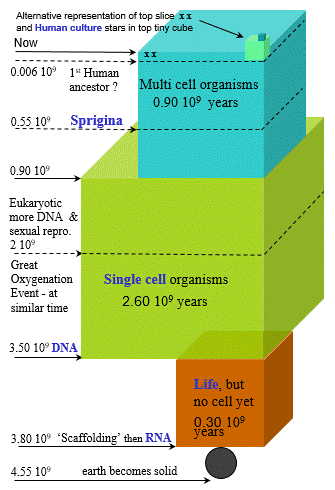
or 1 and 9 zeros
Cells and genes have built an amazing world of chemically based information and processes, or rather such a world has evolved from a foundation of chemical and physical processes. The cell factory in which this amazement happens is both an end and a start, an end because after a very long period of evolution (the big cube in adjacent diagram) a more sophisticated version evolved to form a universal building block, and a start because it forms the basis of the majority of all organic matter on the planet. A key feature (despite the names) within the cell is that: the deoxyribonucleic acid molecules form data for ribonucleic acid polymerase enzymes, which in turn enable the production of new molecules of ribonucleic acid, known as a messenger RNA sequence, and on it goes. Or simply DNA is a molecule representing data that is processed by an enzyme (molecules acting as a process) and this is just a small part of a beautify complex chemical processes within a cell. There’s a vast amount of information on the cell and its operation provided in the BBC Radio 4’s IoT The Cell FAILS. And the end result of all this is that, among many other things, cells created various versions of finches, which helped inspire Darwin to start this particular ball rolling. Although he proposed the evolutionary process of competition and selection, the details of the actual mechanism was not understood until many years later, even though it was available at the time due to Gregor Mendel's work in modern-day Czech Republic - unfortunately no Internet yet.
Not only have cells and evolution built finches, they’ve also build brains including ours. And even I struggle to accept that just cells and the process of evolution has led me to be thinking about this today, and that some agency hasn’t been orchestrating all of this; but although orchestration is the easy temporary answer, it ultimately raises even more questions with some very strange answers. The evolution of simple to complex brains introduces yet another amazing world of brain based information and processing (see). Again it is difficult to comprehend how our ideas have evolved and been realised to create the complex world around us today, just by our own hands in only a few thousand years – or was there an agent whispering in Copernicus' and Galileo's brains? As Darwin saw the finch varieties and wondered how it happened, we can see our world and also wonder how it happened, not from a historic sequence but how it happened at all. How does culture (the accumulated collection of our ideas) evolve?
Comparison is often made between biological gene based evolution and that of culture, it’s useful but only an analogy. Biological evolution is very physical and is recorded in fossils, and the underlying mechanism of evolution i.e. genes can be physically studied and even intervened with gene therapies. But culture is based on ideas that arise in, and transfer between, brains and only exist as firing neuron networks, which don’t lend themselves to useful analysis. However, the effects of ideas can be examined once they are realised - much like gravity, it can’t be seen but the effects are well known, or wind can’t be seen but definitely felt. So much like Darwin, who proposed evolution but knew nothing of the mechanism and genes, we have to theorise on how culture evolved without a physical genetic mechanism to study. …. Darwinian processes are tolerant of how heritable variation is maintained” ref to NBGA – p81.
Another important difference between culture and biological life is that 99.9% of species that ever existed are now extinct and thereby left space for appropriate new life forms. Whereas all known cultural ideas (currently appropriate or not) still exist in some form, possibly as an artefact or perhaps in book within a library, or now via the Internet. This has the advantage that new ideas can readily be built on old ones, each new generation doesn't need to re-invent the wheel before gradually developing bigger and better forms of transport - unlike each new organism being built from original parental body plans, which may by chance slowly build on an already invented wheel or adaptive improvement. Culture therefore both enjoys, by inheriting readymade ideas, and suffers, due to a clutter of extinct ideas, a Lamarckian style of evolution, that is one of inherited parentally acquired characteristics.
The rate of production of genes and cultural ideas is very different too. New genes, or rather we vehicles conveying them, arise for no other reason than an inbuilt sex and reproduction drive giving a relatively slow production rate, while ideas possibly arise due to our curiosity, ingenuity and drive to stay alive and at a very much faster rate. Once there was a relatively small body of substantial ideas that formed an embryonic and slowly growing collection of ideas or culture, possibly starting with how to make a hand axe and moving on to traditional stories told from generation to generation, dictates by Egyptian Pharaohs, Roman engineering drawings, and religious texts etc. Some ideas filtered down (or fed down) to the wider population, but once the printing press was invented around 1436 a broader spectrum of ideas could be easily propagated and the collection of cultural ideas grew quickly in the new fertilised environment. And the arrival of the Internet in 1983 created another game changer, followed by a quickly growing social media in 2006.
We have moved from a small body of substantial ideas to a mass of good ones, not so good ones, and dubious ones too. Propaganda, alternative-facts, miss-selling etc. have been in our culture for probably thousands of years, but modern dissemination, including the new possibility of targeting through social media, has introduced another dramatic step change in culture. The interesting question is, are we in control of our culture or does it drive us - what does the market say?
Evolutionary mechanisums and Not by Genes Alone
Below is my summary of the mechanisms and processes involved in the evolution of culture as compared to biology. Further biological mechanisms feature in ⮝Background and Mechanisms and a lot of reference is made to ideas here that feature in ⮝What is an Idea. The models below highlight my approach to these mechanisum and the content of Not by Genes Alone.
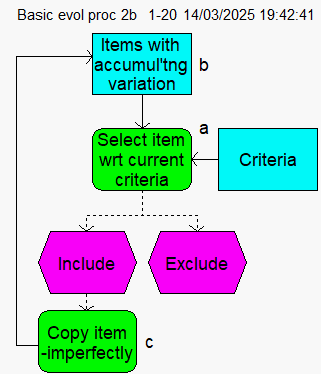
There are two threads running through the book, one is about our ancient ancestors' initial and developing culture, which help them survive in a variety of places and changing climates, and the other is the dramatic escalation of culture once a critical mass of abilities was reached. The overall objective of the book is to demonstrate that all this change was driven by Darwinian processes, and the following models set the Darwinian scene. In On the Origin of Species Darwin famously argued that three conditions are necessary for adaptation by natural selection and they are listed below with a generalisation added - letters relate to adjacent model.
- there must be a "struggle for existence" so that not all individuals survive and reproduce - must be competition and selection, so only those meeting selection criteria are included in further consideration.
- there must be variation so that some types are more likely to survive and reproduce than others - must be variation within the included, so further selection against criteria is possible
- the variation must be heritable so that the offspring of survivors resemble their parents - variation must derive from a previous version in a consistent or reproducible manner and not
random occurrence
But having said that, random genetic variations lead to step changes in evolution ref course⪧name # Lec.xx ⪦ , if useful they continue, if not they literally die out.
Ideas tend to derive from previous ones, for example evolution of the steam engine or the game of Chinese whispers, but how consistent or reproducible are they? Then there’s the randomly occurring “Arthur Sullivan's 1877 lost chord” as good as such ideas may be, if not reproducible they not much use.
However, there are three issues when applying Darwinian evolution to none organic items such as ideas and culture - summarised below and more later:
- Within organic evolution, after a number of years all organic life forms die, however if suitable they may have contributed their genes momentarily to the pool, but nothing more than possibly nurturing offspring containing their genes, that is until culture took off.
But non organic ideas don't die (assuming they have left the brain before death) and the pool of "b- Items with accumul'tng variation" can just get bigger and bigger, and some life forms (people) do get to leave more than genes in the form of long standing ideas - see model description {perhaps not - content available "description of items" but model description is via All Models as it's in the model's htm file, which also need sorting, tests done in descriptions-img-1 g0129301.htm also Active x warnings but not in browsers}. - With organics the selection criteria (a-) is simply: has an organism that contains a particular set of genes, survived long enough to become sexually fertile? If so they proliferate their set of genes, if not, their gene set was possibly not appropriate for the times.
To be selected ideas rely on appealing to us, some may be appreciated as practical survival ideas such as making hand axes, but most, especially nowadays, have a lot more complexity in their appeal, influenced by many factors including debate about their value and veracity - Genes are the foundation of organic evolution and reproduce by a precise mechanism that includes small and appropriate levels of variation (c-), but the system can also cope with occasional big change - i.e. just to give it a go.
We sometimes reiterate or copy ideas without change, such as making hand axes, or ideas hot off the printing press, while at other times, with the best will in the world, copying is not so good e.g. the game of Chinese whispers; and of course we also deliberately add our own opinion or value-add to an idea while copying or passing it on.
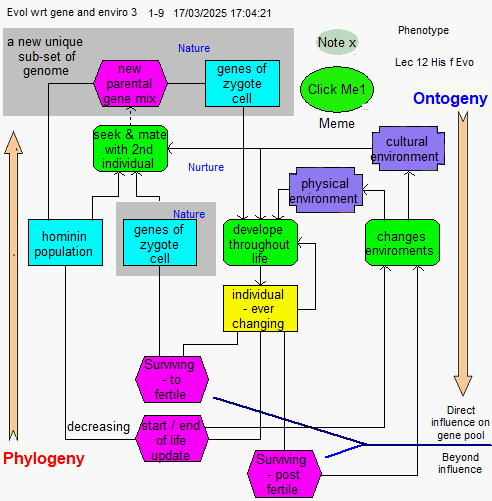
We are of course the source of these ideas and how we evolved to have them is shown in a bit more detail on the right. The model shows the principles of how an individual human comes into existence, develops (ontogeny) and possibly contributes to the evolution of the species (phylogeny) and its culture.
- The centre process “develop throughout life” has an input of the zygote cell (fertilised egg) and an output of an “individual - who is ever changing”, from a developing foetus, to a baby, to an adolescent, parent and elderly adult with help from modern care. The process includes development of the individual based on the cards dealt by the initial genes (zygote) and early environment, which provides the foundations for musical genius, to the not so bright, and also progresses through life with ideas sought and gained. The individual is a combination of their instance of Nature of Brain, as determined by zygote and environments, plus further influences of physical and cultural environments. Further explanation in xxx
- There are 3 critical milestones or events: the word event is a little flexible here, the event may be reaching the milestone, but also include the journey to it. Elsewhere an event may be a performance of some sort that may last a few hours. surviving long enough to become fertile and possibly creating other human(s), a life from start to finish, and a life post fertility. From a basic gene point of view the last event is just an unnecessary drain on resources, however thanks to our culture that includes able grandparents, practising doctors etc. this period now enhances individuals' gene proliferation.
- The event dotted lines {there arnt any} are inputs to the process “changes environments” and represent that we all contribute (past it or not) in some way to the changing physical and cultural environments. The solid event line highlights that an individual is part of the population for a limited period only, pretty obvious but essential for the operation of evolution - this contrasts to ideas that never die completely and leads to culture.
Assuming that most individuals create more than one individual the hominin population will grow along with a growing pool of genes of a particular types. The gene pool is contained by the group of people, but as groups become isolated (often by geological changes) there’s a chance for the constituent parts of pool gene types, leading to a new species or variant. This model shows just a single principle population.
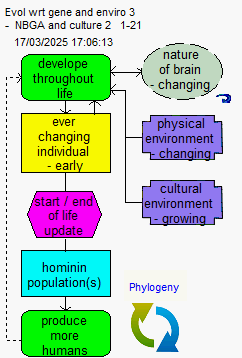
This model is a simplified version of the above and highlights how we evolved over millions of years. In itself it’s trivially simple, but it serves to highlight the changing nature of brain, cultural and physical environments that are important to each and every person, as featured above, and who contributed to our evolution and the growing hominin population(s). Although not explicitly shown, this model can be applied to our dispersal to different regions of the world and our split into many different species; hence this model shows hominin population(s) and you can imagine an individual instance of the model for each population. These populations may also be isolated groups of the same species, who over time and isolation become the different species; but with the passing of even more time become extinct as they don’t change appropriately to meet the physical environment present in their particular instance of the model. Eventually all instances of the model disappear to leave we Homo sapiens operating in the last instance, with our nature of brain largely changed, a huge cultural environment and, thanks to us, another challenging physical environment.
The total time frame of the many instances of phylogenetic cycling (sounds fun) is about 7 million years and
Not by Genes Alone covers around the last 2.5 to 3.5 million years of this period. This period is subdivided by
- one thread covering the early period, where the nature of brain is very basic and likewise the ideas constituting culture, while a
- second thread covers roughly the last million years, when cultural development is dramatically accelerating. There’s no specific boundary point between the two threads, but the idea of "tribal instincts" (seeding cultural group selection) is key to the authors' explanation of our unique broad and extensive social organisation.
I also suggest that this was the time when the key evolutionary driver was beginning to change from genes to ideas. Richard Dawkins’ meme ♥ is implicated here, but I think the ideas around memes need broadening to cover this new era of data driven evolution. The objective of Not by Genes Alone is to show that our culture evolved in a Darwinian style on “cultural variants” in Not by Genes Alone’s terminology, or on “ideas” in my terminology. But ideas are a lot vaguer than genes, and whereas genes are copied by a precise mechanisms, the copying of ideas is subject to the vagaries of human thought and actions.
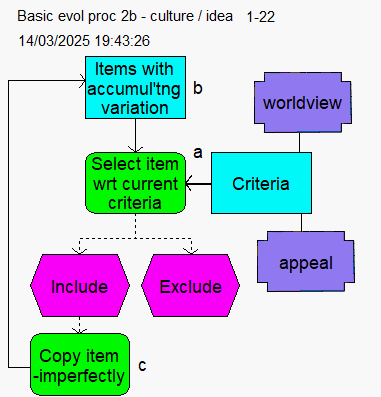
The previous basic Darwinian process model appears again here with Worldview and Appeal Components added so that it covers ideas, the three key descriptions are updated appropriately too.
- Must be competition and selection, so only those meeting selection criteria are included in further consideration. In the case of genes selection criteria is simple, has the person survived long enough and so able to reproduce their genes, but our selection of ideas is a lot more complex. There are two major factors: we each have a personal set of opinions about the world or a worldview, and we are all subject to the emotional appeal of ideas.
- Must be variation within the included set, so that further selection against criteria is possible. There are certainly a lot of different ideas to choose from and the pool in this case just gets bigger.
- Variation must derive from a previous version in a consistent or reproducible manner and not random occurrence. Sometimes ideas do derive from previous ones such as: reasoned arguments, scientific research and the development of practical objects, but at other times one idea may inspire another, but may be on a different path and not necessarily a development of the original.
But is all this still a Darwinian process - possibly? There are lots of different ideas from which to select and we have limited capacity, both personally and within contemporary culture, to attend to ideas, so there’s competition among them to be adopted. But they are not directly copied or derived from a parent idea, although they can relate to a parental groups such as: politics – different systems, parties, policies etc.; science – gaining an understanding of a specific areas; religion – many different ones all with their own sets of ideas. However, the debatable principle is selection, there is no absolute stable criteria as in the case of genes, and we have free will to decide on the criteria. Or do we, Richard Dawkins, and another meme enthusiast Susan Blackmore, might say that ideas are in charge and are setting the criteria. This might be the case where idea appeal is strongly biased to emotions, or if you want to re-create granny’s soup (a Susan Blackmore favourite). And you can also argue that, as ideas were key to the co-evolution of our brains, which evolved to process them, that they have created a self-interested environment suitable for themselves. Are ideas ultimately in change, do we have free will to make our of selection criteria, or is it just the way it works with our particular style of evolved information processing brains, sometimes analysing ideas in a Darwinian style but at other times just going for it?
The right hand model is an adaption to highlight the long term evolution (the phylogeny) of we hominins.
Although the "selfish" selection of individual gene(s) is stressed above {or somewhwe}, a long time accumulation of selected genes creates a particular sort of human, which is the subject of this model. Therefore this model represents the development of an individual {collection of selfish genes working together} in relation to physical and cultural environments and the related genetic evolution of the population as it moves through, or across, the many past versions of us – for more xxx
what is time periods – 1st slow build of ideas and cultural xfr horizontal (mimic social learning) and vertical generational / culture. Was last million yrs of Pleistocene climate variation a booster to this slow grow, once boosted did it grow exponentially through culture especially after language – “The results suggest that language first evolved around 50,000–150,000 years ago, which is around the time when modern Homo sapiens evolved” – Goo when did human language start
don’t forget - We've come a long way culturally in 10,000 years, but we should keep in mind - that that mind is - the same one that scanned the plains of equatorial Africa in the days of our Pleistocene ancestors. (Workman / Reader 2009)
This model is a gross simplification showing just three basic periods, the first representing the first 5.8 million years, the 2nd the Pleistocene period 80k years ago (1st axes?) and 3rd the Holocene period just 10k years ago. NBGA suggests that the last two periods are the time that our modern brain features and culture started to appear.
lots of info in C:\Users\Tom\Dropbox\web stuff\4- CONTROL and DRAFT Pages\docs and pics\Not by genes alone\Peter Richerson - Not by Genes Alone How Culture Transformed Human Evolution - text.pdf highlights and comment boxes, also in xx
The period considered in Not by Genes Alone
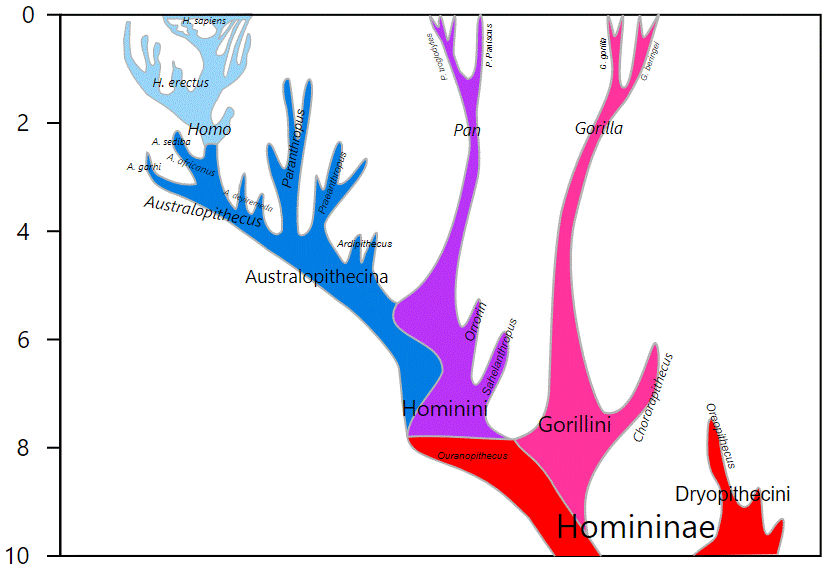
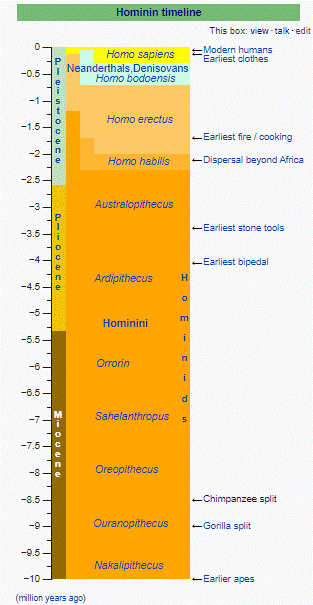
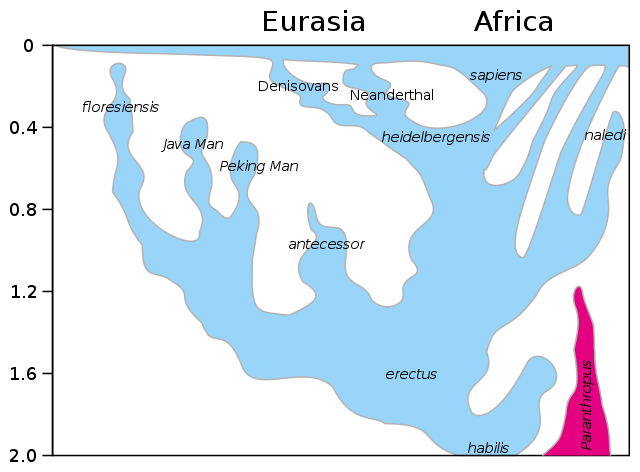
The evolution of our hominin line covers around 6 to 8 million years including the split with Chimps and Bonobos (Pan), as shown in the adjacent diagram. The actual branching took over 2 million years to complete, as shown by the white S in a period of "hybridization process within Hominini .. ongoing 8 to 6 Mya" - see detail of diagram - and “interspecies mating between "proto-human" and "proto-chimpanzees" nonetheless occurred regularly enough to change certain genes in the new gene pool” - see Human evolution - The genetic revolution.
But no matter the duration or the cause of the branch, it resulted in Hominins leaving the forests and eventually existing as Homo Sapiens in all areas of the world including forests, while the Pan line continued to evolve, although much less than the Hominins, and they are still constrained to forests.
So why did we start to leave the forests, perhaps pushed out from the edges by overpopulation and thus a lack of territories and food, no matter, the absence of trees would have been a strange, dangerous and challenging place for a forest dweller. Leaving may have been tentative and followed by a return to safety if they could, and nothing was done in a hurry, it took 2 million years for hominins to complete their tree independence, with many additional premature deaths in the process, that’s evolution for you – it’s the white S again.
An obvious requirement for life outside the forests is a means of movement and life style independent of trees. Modern apes can walk bipedally for short periods and there’s evidence of ancestral bipedalism e.g. Danuvius guggenmosi 11.6 mya. So we had the foundations that could evolve within us to become exclusively bipedal, but again it took a while. The adjacent chart shows Earliest bipedal as 4 mya (presumably persistently bipedal) and "it's not until the emergence of H. erectus 1.89 million years ago that hominids grew tall, evolved long legs and became completely terrestrial creatures" Smithsonian Magazine
As we wanted, or had to, start moving around beyond the trees an evolutionary selection criteria was establish, which led to more proficient movement and in turn enabling more adventurous dispersal, creating a spiral of slow improvement - started by a self-imposed selection that became the first steps on the long journey to perfection. Or possibly it may have happened the other way round, instead of a desire or necessity to improve basic bipedalism, a fortuitous event happened that enabled improvement, dispersal and perfection. Possibly someone living on the edge of a forest and who also had the gift possibly given by a small tweak genetic improvement leading to a long evolutionary path, or a chance step change genetic mutation that established a new starting point in evolution ⪧Origins of the Human Mind 10 Lec.14 Macroevolution ⪦ of better upright walking, ventured out one day and found a plentiful food source. They returned many times and became fitter thanks to the new food and / or source, they had lots of children and past on the walking gift baton to future generations who used it to explore and colonise new niche areas beyond the forest.
Having left the comfort of the traditional family home environment, what next on the to do list? The new savanna style environment provided many opportunities and problems to solve, so not only requiring appropriate movement but also a problem solving brain. Again we had the foundations and our new environment provided the evolutionary selection criteria to evolve a more appropriate brain. After a few more million years our traditional family home environment had grown to be Africa, which became populated by several different species of ancestors who had adapted to different local environments including varying climates over space and time. One particular late addition, which included the best bells and whistles of previous models, was Homo Sapien – the master of adaptability - see adjacent diagrams {but not mention of types & fashion here}.
The African hominin factory hadn’t stood in isolation and various models had been tested in the wider world from time to time with intermittent dispersals – of course not forgetting there was no factory manager in charge, it was just grass roots try it and see. And of course the African factory didn’t have exclusive production rights, other models such as Neanderthals evolved out in the field and even interbreed with early Homo Sapiens from time to time. However, the “piece de resistance” was modern Homo Sapien who possibly left the factory around 70,000 years ago and went on to interbreed with existing models. Eventually hybrid versions of modern Homo Sapien were the last model style standing, this one continued to replace all previous models and expanded to swamp the planet. yyyy
Interesting note - {for here or somewhere – intro? re New Humanist} Has our specie’s monopoly on the planet removed competitive evolution, are we it? At one time there were several versions of hominins on the planet including Neanderthals, but eventually we out competed them all to become the single selected version. We hold the monopoly position with no direct competition, is this the best it gets from a physical evolution perspective? But there is our ability to process information and create ideas, however they are often fraught and polluted by our particular style of information processing.
Recent study of the TLKT1 gene highlights this and leads to a hypothesis that the human version of TLKT1 gene drives significantly greater proliferation of young brain cells in the neocortex when compared to Neanderthal’s version and leads to greater density of neurons within it, among early humans, potentially contributing to our cognitive advantage over Neanderthals and other extinct hominins (Ref from New Humanist Winter 2022 Close cousins - Lydia Leon p 15)
There are many theories about when and how we left Africa (as below), but an important question is why we left. Once leaving the trees our ancestors were no longer buttressed by relatively stable forest climate and as they spread to varying climatic regions of Africa, which also changed over time, they faced many challenges. These environmental challenges induced selective pressures to create different species, with some better able to adapt to variations than others. However, greater general climatic change worldwide also occurred that initiated a need to find less challenging climates and better opportunities, those that could migrated out of Africa to start the eventually population of the world xxxx.
Once across and into the Middle East they spread eastwards and northward to encounter a colder climate and yet more opportunities to solve. This strategy of looking for oportunities and solutions has continued to the point where we Homo Sapiens survive in all regions of the world, some with bitterly cold blizzards, to hot arid deserts – but before we gettoo carried away, not so much a strategy, more a happenstance.
Some input from Wikipedia
From: Early human migrations
Early human migrations are the earliest migrations and expansions of archaic and modern humans across continents. They are believed to have begun approximately 2 million years ago with the early expansions out of Africa by Homo erectus. This initial migration was followed by other archaic humans including H. heidelbergensis, which lived around 500,000 years ago and was the likely ancestor of Denisovans and Neanderthals as well as modern humans. Early hominids likely "crossed land bridges that were eventually covered in water" (History Alive, pub. 2004, TCI[full citation needed]).
Within Africa, Homo sapiens dispersed around the time of its speciation, roughly 300,000 years ago.[note 1][3] The recent African origin paradigm suggests that the anatomically modern humans outside of Africa descend from a population of Homo sapiens migrating from East Africa roughly 70–50,000 years ago and spreading along the southern coast of Asia and to Oceania by about 50,000 years ago. Modern humans spread across Europe about 40,000 years ago.
From: Human evolution
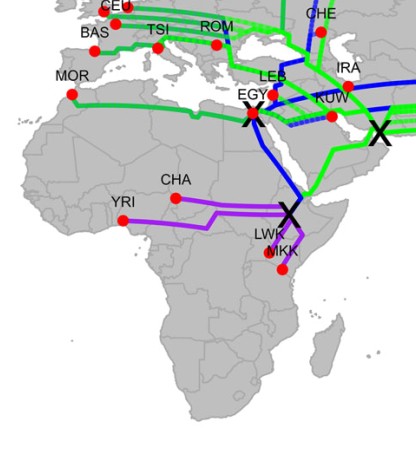
xxxx The introduction of genetic evidence has supported some earlier theories, but put others in doubt e.g. 1988 Milford H. Wolpoff - "The multiregional hypothesis proposed that the genus Homo contained only a single interconnected population as it does today (not separate species), and that its evolution took place worldwide continuously over the last couple of million years". The "out of Africa" model continues with a possibility of “a coastal dispersal of modern humans from the Horn of Africa crossing the Bab el Mandib to Yemen at a lower sea level around 70,000 years ago” and this version of H Sapiens depending on marine resources for their survival. A second wave is also suggested, also crossing the Bab el Mandib, but then heading to the "Persian Gulf oases, and Zagros Mountains into the Middle East". Or alternatively the second wave may have crossed the yet to be built Suez Canal and into the Sinai Peninsula and Asia, occurring "shortly after 50,000 years ago and resulting in the bulk of the human populations of Eurasia". This second wave possibly possessed a more sophisticated "big game hunting" tool technology and was less dependent on coastal food sources than the first wave.
However, this multiple dispersal model is contradicted by studies indicating that the populations of Eurasia and the populations of Southeast Asia and Oceania are all descended from the same mitochondrial DNA L3 lineages, which support a single migration out of Africa that gave rise to all non-African populations - a single wave that left Africa between 65,000 and 50,000 years ago.
Amazingly the Suez Canal was built only 50,000 years after this probable dispersal route, where have the million year timescales gone? And an even shorter timescale, while the canal was being built in 1859 Gregor Mendel was experimenting with sweet peas and suggested the existence of something like genes (the missing element from Darwin’s theory of 1859), and less than 150 years later Mitochondrial DNA and Y-chromosome DNA sequencing has provided additional evidence to support the idea that this area was part of a dispersal route taken by our ancestors 50,000 years ago, and where have the thousand year timescales gone?
This dramatic shortening of timescales of human events in relation to geological epochs and hominin evolution is at the core of this site and Not by Genes Alone. The chart above shows geological epochs, of which the Pliocene and Pleistocene are of interest here, and details the different versions of our ancestors and major activities milestones - with a very late eye to fashion. A more detail chart of {my} time line of survival and socialising culture ideas.
https://www.smithsonianmag.com/science-nature/new-ancient-ape-species-rewrites-story-bipedalism-180973479/
Orig - However this 2 million years saw our evolution to bipedal travel suitable for the savanna {was it during this 2 million years - debate as to when - chart shows earliest bi pedal 4 mya
https://www.newscientist.com/article/dn12438-ancient-ape-was-an-early-swinger/
"A study of a 9.5-million-year-old fossil of the ape Hispanopithecus laietanus reveals that it had fingers that were longer than those of a modern gorilla or human, but not as long as those of an orang-utan: an arrangement of bones unique among all known apes, alive or extinct. That would have allowed it to hang from tree branches as orang-utans do, but also walk on all fours along the larger branches with its palms flat on the surface."
but also - https://www.newscientist.com/article/2269038-earliest-human-ancestors-may-have-swung-on-branches-like-chimps/
Climate changes
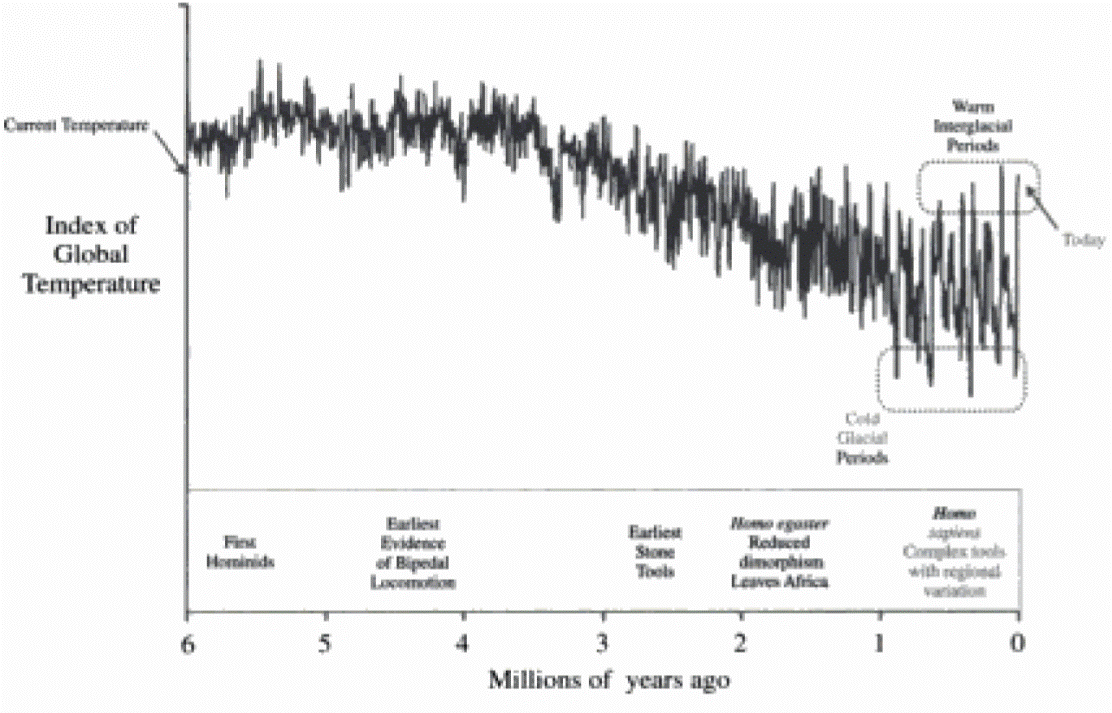
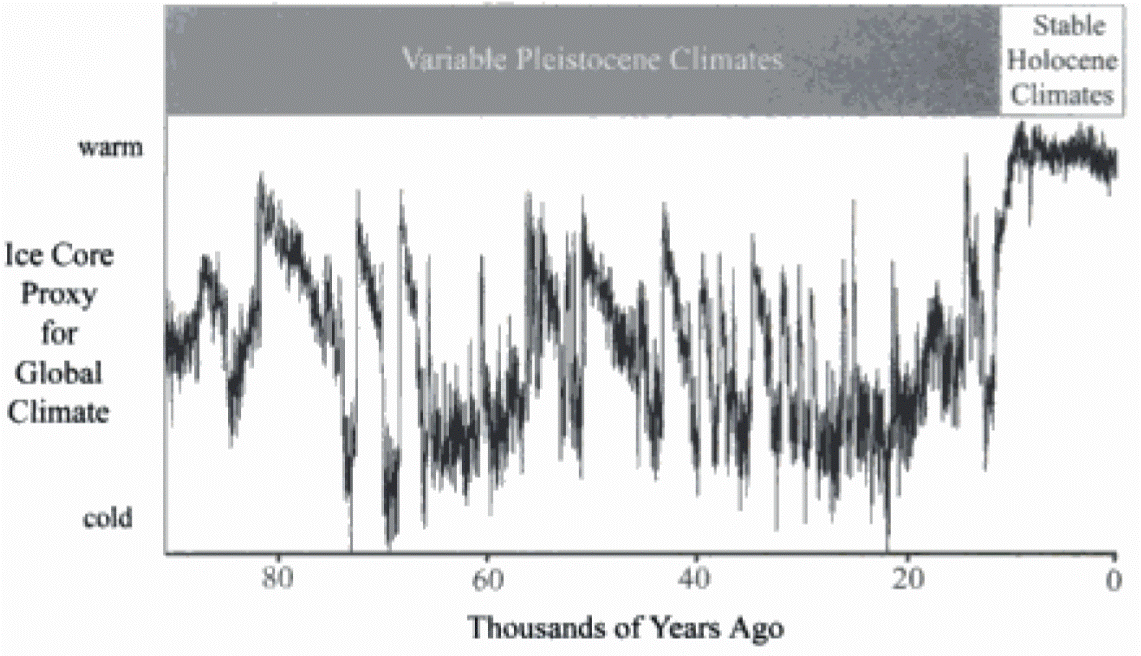
In Not by Genes Alone Richerson and Boyd describe how the climate cooled over the Pliocene and Pleistocene periods (the great ice age), but during the period's last million years the climate became very variable before settling to become warmer in Holocene period starting just 10,000 years ago - as in diagrams below. The authors also suggest that the variation period created a strong evolutionary selection driver for creatures adapting to the constantly changing long-term physical environment and that - "The Pleistocene climate deterioration is correlated with increases in brain size in many mammalian lineages besides our own". This drove the evolution of our brain psychology such as to enable our ancestors to adapt to rapidly changing climate and so our abilities around “Social learning may be an adaptation to Pleistocene climate fluctuation” (131?).
There is a loose corelation to chart # that shows dispersal from Africa starting at around 2 my and evolution of basic hominins within Africa from about 8 mya to 2 mya. - find NBGA climate graph and add
Bigger and better brains, which enable variable and appropriate adaptive behaviours, is a good survival strategy, and one that we fully exploited.
But paradoxically once the climate became more settled in the Holocene period we continued with our new brain style - “Shouldn‘t the quiet climate of the last eleven thousand years have led to dramatic economics of expensive nervous-system tissue, degrading the cultural system?” - p146. Although no longer needing to adapt to a varying climate, being adaptable to other changes turned out to be a price worth paying for an expensive nervous-system. Once our adaptive genie was out of the bottle and enabled our culture, gene driven selection was outpaced, not relegated to being viewed in the rear-view mirror, genes are still part of the vehicle but their selection is very much in the back seat - at least for now.
If true, it’s ironic that climate change was a driver for our modern brain style and culture, which is now pushing the world towards a climate catastrophe.
Review of Not by Genes Alone
When the book was published in 2005 the authors had concerns that many of their academic colleagues did not agree on how culture evolves, or if it even does. Their book therefore considers culture, how it varies and changes, and offers an explanation based on Darwinian principles.
However, having said that book sets out to follow The path not taken (page 16) by Darwin. By this the authors mean that although Darwin originated the idea of natural selection via variation and competition he still believed that habits, or behaviours, could be inherited from parents. This aligned with Lamarck's contemporary theory of inherited characteristics, such as a son inheriting his blacksmith father's strong muscles, plus his behaviour of industrial work ethic. The book describes how behaviours and ideas that are ultimately part of culture, can be passed through generations without resorting to inheritance of acquired characteristics and instead via natural selection and in some cases genes.
There are two threads running through the book relating to cultural evolution, which are demonstrated by many examples of cultural variants in the authors' terminology this is a piece of culture, or in my terms an idea, one thread is the variants fitness from a genetic view and the other thread is fitness from a cultural or social view - in both cases fitness is in the sense of Darwin’s survival of the fittest, or put another way adaptive to evolution.
- First thread cultural variants have a direct influence on our existence, basic practical ideas such as how to make effective tools to help obtain and prepare food, or appropriate basic social behaviours. Those able to embrace these ideas will possibly live a bit longer and have more children, who will grow up within a tool making family and acquire the skill, or possibly adults will see the value of a tool, or good behaviour, and imitate its production and use, leading to more healthier child-rearers – a cultural variant resulting in more genes, or the other way round, genes enabling the spread of a cultural varient, but only indirectly The lightening of skin colour as we left Africa to populate darker climes was a simple genetic adaption to maintain good vitamin D levels. Making an axe may also help survival, however it’s not the method of axe production that is conveyed by genes, it’s the ability to appreciate and reproduce a good method of producing anything – a far more useful ability. XX monkey watch chimps termite fish but don’t have the wit to imitate the action.{but imitating axe making and use is idea xfr without genes, but proliferation is via genes (why how? – indirectly via genes as they provide the capabilities to inspiration and desire to imitate thereby spreading the idea}. If the inspired tool maker dies prematurely, so does the idea.
- Second thread cultural variants have an influence on our social life rather than our existence, the variant is perpetuated by people doing it just because it’s an attractive, or useful thing to do e.g. burying the dead, which is a relatively recent innovation and done by Neanderthals; it's possibly a good health practice, but it doesn’t have to be done with reverence as indicated by burial sites. These variants are of little direct benefit to genes, but make society run better and so catch on.
Survival Cultural Variant - 1st thread

These varients are about simple survival and our early ancestral evolution, or coevolution of our brain and growing "survival culture" (how to make tools, manage fire etc), which lead to the development our phycology to enable more culture, as it was showing itself to be a good survival feature. As mentioned above, survival skills (or rather the ideas representing them) spread via social teaching or learning and improved by innovators; those individuals with gene variants “for” teaching, learning or innovation populated society with better brains.
Better new brain structures or phycology included all the necessary paraphernalia, starting with being able to identify a good idea probably thanks to our common ancestor with chimps and bonobos we were off to a a good start - although Baboons also enjoy eating termites, and despite watching chimpanzees “fish” for termites, no baboon has been seen to do the same – they just wait for termites to fly out; whereas Chimpanzees will watch and pick up new behaviours from each other, but also other creatures?, then being able to mimic complex and novel behaviour, appreciate its wider application and possibly improve it. Also included were new emotions such as shame and guilt to make living in groups work better (p214). Other early social skill may include cooperation, starting with simple reciprocal behaviour algorithms {ref} and expanding via mechanism discussed in Culture and Gene Coevolve (p201 etc) - social organisation together with language are two of our species defining attributes. We originated from a social species, but as our social groups became more sophisticated those possessing early inclination of better social skills would again possibly be more attractive to others and lead to more children with the embryonic new phycology. However, though socially based these changes are gene proliferated, e.g. variant gene “for” shame. This period of genetic evolution lasted a long time and involved different species of us with steadily growing brain size – see adjacent Natural History display
To reiterate - genes are driving our brain evolution, they are not transferring the cultural variants or ideas, these are being transferred among living individuals by imitation, and social teaching or learning, and at that time without the benifit of an agreed language. The genes are responding to the success of these ideas and building bodies (brains, larynx etc.) better able to exploit the possibilities. But there is one area where genes do get involved in transferring ideas and that is the BIOSthat all creature have – it's the start-up and defining instructions appropriate to the brain architecture, as our brains evolved under genetic evolution the start-up instructions have to come with the genetic package. This is still the era of genes selecting favourable behaviours and physiology (gracile, robustbody, skin colur etc) for themselves.
Socialising Cultural Variant - 2nd thread
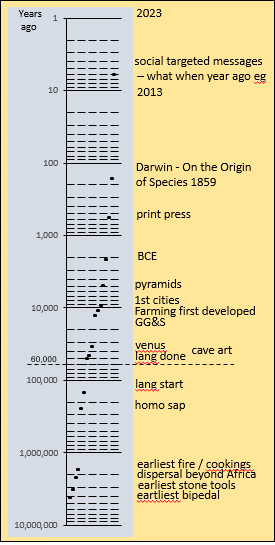
Base 10 log scale is used to show a wide range of time. Each equidistant cycle represents a 10 fold change in values and each dashed line is a tenth of the cycle.
Example: starting at 10,000 years ago just before the 1st cities at 9,500 ya. The period below to the dashed line, which is at 20,000 ya, includes the time that the book Guns Germs and Steel goes back to i.e. 13 kya; the next dashed line is at 30 kya and just before The Venus of Hohle Fels at more than 35 kya. There are then 40 and 50 kya lines, followed by an emphasised one at 60 kya when culture took off (possibly aided by well-established language) and is also probably the transision period from Survival to Socialising Cultural Variants.
There continues 70 80 90 kya lines followed by a solid one for 100,000 ya when another cycle starts and the dashed lines are at 200 300 etc. kya. This cycle includes the start of language and the establishment of Homo Sapiens and continues back to 1 million years ago and another cycle with dashed lines now at 2 3 etc. mya going back to 10 mya.
{How does this co-ordinate with our expansion over the world - good image somewhere}
These varients only becomes widespread in hominis (and only us) after years of survival varients, acquiring a brain architecture aligned to culture took a very long time, the need (or survival criteria) was primed and initiated by simple survival ideas transferring between ancient us, but little by little we stretched to ideas beyond just basic survival, and with the aid of bigger, better and appropriate phycology we got to develop formal language, ultimately progressing to being written. With language, ideas could become more sophisticated (language isn’t essential for thinking, but it probably improves it) and ideas easily transferred horizontally to others, and vertically to the next generation with ease, even if initially only verbally. All now done without help from genes, an "expansive culture" of ideas was now helping us survive. But this was just the start, hunting and gathering moving on to agriculture and then forming cities that need social organisation and cooperation way beyond our ape ancestors social life, as ideas became more dense within city living they expanded in style - see adjacent idea time line diagram.
- {homo sap 250kya, language first evolved around 50–150k kya, 1st cave art 45.5 kya, 1st un disputed Venus 35-40 kya, GG&S 13kya - what happend to the time line drawing}
Topics raised
The book raises an interesting anomaly and covers some interesting topics, introduced here and expanded below:
- Chapter 5 Culture is Maladaptive - raises the question, if genetic evolution created an appropriate psychology to exploit the benefits of an initial survival culture, why do we behave or have ideas that are unfavourable to genes, or maladaptive Evolution is meant to promote things that make creates more adaptive to the environment, and not those that are maladaptive to it. The peacock’s excessively cumbersome tail can be said to be maladaptive, but can be explained by runaway sexual preference i.e. females fancying males with big tails - as in Darwin's The Descent of Man, and Selection in Relation to Sex.
- Chapter 6 Culture and Gene Coevolve - discusses our two defining characteristics, language and widespread social cooperation and suggests how they possibly evolved within our culture.
- Chapter 6 – p206 discusses the mechanics of group selection and the difference between species and cultural groups
- The idea of "tribal instincts" is key to the authors' explanation of our unique broad and extensive social organisation. However, it appears to be a proposition with no explanation as to how they occurred. {is this in chapter 6? - if yes ref or why not at bottom}
- Chapter 6 – argues that culture evolves in a Darwinian style. After a review of how natural selection, mutation, and drift shape gene frequencies (p192) they suggest that natural selection, guided variation, and a variety of transmission biases mould the distribution of cultural variants. They draw a parallel between genes and cultural variants, but is it fair to say that variants evolve in a Darwinian manner?
1. Maladaptive anomoly
The authors suggest that as cultural grew and spread, the traditional more gene favourable ideas of parents became diluted with less gene friendly ideas - parents have a genetically oriented interest in spreading their genes. Genes may have created a good survival scheme based on ideas, but the scheme has now been hijacked by the ideas themselves for their own benefit, with the ultimate insult - the realisation of simple and effective contraception.
p 151 - big mistake (individual based) v costly info (population & cultural adaption)
2. Language and social cooperation
The authors suggest that our culture extended beyond those of our evolutionary cousins, the chimps and bonobos, because we acquired additional tribal social instincts (p 196, 215, 221, 226, 228, 230, 234, 235). These additional instincts conflict with our basic kin related instincts (as shared with our ancestral relatives) and so can be regarded as maladaptive, or to some as the wrong explanation. However, their defence is that there are similar explanations accepted as to how we developed language.
A large part of our brain is given over to language and this situation obviously evolved over a long time. It would be reasonable to assume that ancient tentative communication attempts conferred an advantage on those involved and that probably some were luckily better equipped to communicate than others. In true Darwinian fashion such better equipped individuals may have survived to reproduce more often, or for longer, or been more attractive mates, or reared their children (with the gift) more productively – however it was, it worked, we are communicating. But the actual mechanism and foundations for language, which enabled the above further evolution, evolved long ago as shown by communication between all animal in some form - our chimp and bonobo cousins being better than most. We are all equipped to make and recognise our signature tunes and sounds, but we pushed it a stage further than our cousins by improving our ability to make more sophisticated sounds (at the expense of choking more easily) and of course the ability to hear and distinguish such sounds. This is still a long way from language, which relies on conventions of sounds and meaning, and layers of composite structure. Physical evolution gave us the building blocks of sophisticated sounds, but embryonic culture gave us the opportunity to devise languages and obviously done separately in many different locations - bird song is sophisticated too and could contain much information, but did they didn’t extend it with additional language convention, as far as we know, interestingly bats have used sound into what we call sight.
Returning to the defence tribal social instincts, buttressed by language explanations, the authors say “Initially languages must have been acquired using mechanisms not specifically adapted for language learning.” P216 - that is the coevolution selection benefit of communicating and the abilities of an embryonic culture to allow conventions to develop over many thousands of generations. This obviously didn’t happen within a single family but was helped by people coming together, benefiting from blossoming language and so enabling and encouraging more group activity. So in parallel coevolving better social interactive abilities and possibly tribal social instincts built on basic kin instincts.
In the words and discussion of the book, in Chapter 6 - Culture and Gene Coevolve - “These new tribal social instincts {what the f are they} were superimposed onto human psychology without eliminating those that favour friends and kin” (p215) and so suggesting that this caused a conflict to instinctive behaviours, and suggest that: “most other animals are spared such distress [or conflict], because they are motivated only by sel?shness and nepotism [or simple kin and possibly friend selection]”. Others suggest this is wrong and unnecessarily complex, the simpler proposal is that “our culture is shaped by a psychology adapted to small groups of relatives” and no additional layer of new tribal social instincts is necessary – but is it really complex or just what happens.
3. Mechanics of Cultural Group selection
Group selection based on species was once an accepted idea e.g. Marlin Perkins, Wild Kingdom - elderly wilder beast sacrificing itself to crocodiles to help others cross a river in greater safety ⪧Biology and Human Behavior - The Neurological Origins of Individuality # Lec. 10 - The Evolution of Behavior @ 9 mins ⪦ . However, ideas have since changed (the elderly are more likely just to fall in, and not make a sacrificial jump), and selfless behaviours have been countered by Dawkin’s selfish gene ideas {book ref}. However, the authors here give a justification for cultural group selection, as described in “Heritable variation between groups + intergroup conflict = group selection” p206
They start their argument with a summary of Darwin’s principles of evolution, that can be applied to any reproducing entity — molecules, genes, and cultural groups (and even aerofoil design):
- there must be a “struggle for existence" so that not all individuals survive and reproduce
- there must be "variation" so that some types are more likely to survive and reproduce than others
- the variation must be "heritable" so that the off-spring of survivors resemble their parents
The last condition is where species group selection fails, because a species is not a single entity and doesn’t inherit any features. It’s only the individual members that inherit features via genes, the norm of the species may change, but that only reflects many individual changes. However cultural social groups are subtly different, the group does have an identity of its own that does continue regardless of individuals, for example the Catholic Church has well establish tenants, which have persisted for many generations of members. But other groups, for example tribes, may be more subject to variation as they struggle for existence with neighbouring tribes, and over time one group's ideas may be more appropriate (fit for purpose in current environment) and eliminate or subsume the other - the winning group continuing with its defining identity and ideas.
Darwinian evolution of social groups is further supported by: ”In the early 1970s, an eccentric retired engineer named George Price published two papers that presented a genuinely new way to think about evolution” – p202:
"Price argued that it was also "Up until that time, most evolutionary theory was based on an accounting system that kept track of the fitness of different genes. To understand the evolution of a particular trait, one needed to know how the behavior of others affects each individual carrying a particular gene and average this over all situations in which individuals find themselves (just as we did above in explaining kin selection and reciprocity)." fruitful to think about selection occurring in a series of nested levels:
- among genes within an individual
- among individuals within groups
- and among groups
and he invented a very powerful mathematical formalism, now called the Price covariance equation, for describing these processes. Using Price's method, kin selection is conceptualized as occurring at two levels: selection within family groups (favouring defectors) and selection among family groups (favouring helpers)."
this is all my opinion on their work - MOVE TO MY BITS?
The term "series of nested levels" is interesting as it’s similar to the computing idea of iteration through nested loops of procedures, which could also accommodate George Price’s 3 levels of: genes’ influence on individuals, individuals’ influence on the group, and groups’ influence upon other groups. This nesting can also be applied to the co-evolution of gene determined physical and behavioural bodies against the ongoing cultural ideas persisting over generations. Initially genes provide basic behaviours (like all animals) but in our case extended brain enhancement led to language and planning ability via ideas that could be exchanged and inherited by subsequent generations. Some ideas enabled survival better than others and formed our embryonic survival culture that grew with time. This early stage of brain and idea co-evolution equates to Price’s i) and ii) where individuals are interacting within small groups to survive as well as they can, and also equates to Richerson’s and Boyd’s 1st thread of Survival Cultural Variant development where the two processes dance round each other for thousands, if not millions rudimentary culture exists in other animals where, for example, parents teach their offspring how to hunt etc. and it’s not just a feature of our 8 mya common ancestor. of generations. This is the same process for any evolution, but in our case we somehow got survival culture off the ground and flying.
As the groups became established with their particularly successful individuals, aided by their ideas and traditions, the groups obtained their own identities based on the sum of its team players and at this time Price’s iii) of intergroup competition and Richerson’s and Boyd’s 2nd thread of Socialising Cultural Variant kicked in (IS THIS TRUE or is there some overlaps going on?)
ORIG The term "series of nested levels" is interesting here, in computing terms it implies iteration through nested loops - where something is done, you return to a higher level of the loop nest, to do “something else” and return to do the lower loop again, but with the “something else” in place this time. This applies well to coevolution, where there are two loops of change occurring, one driven by genes and another in our case by survival culture ideas and resulting behaviours. Genes provide abilities, some enabling survival better than others (again in our case including embryonic survival culture) and so are enhanced and expanded. The two loops contiue dancing round each other for thousands, if not millions rudimentary culture exists in other animals where, for example, parents teach their offspring how to hunt etc. and its not just a feature of our 8 mya common ancestor. of generations. This is the same process for any evolution, but in our case we somehow got survival culture off the ground and flying.
I'm not sure if this computer style nesting is implicit in the mathematics of the Price covariance equation (it's beyond me), but to me the first two levels above (individual and individuals in groups) cover our early days of coevolution when genes had time to play a part, but did the nesting change once the pace of change out ran genes? Did the same style of coevolutionary process continued, but now at levels ii and iii (possibly 3 levels operated for a time, but level i eventually dropped out). Groups have a defining style generated by the majority of its members and the group style tends to stabilise as members conform to the group’s standard. However, some groups become more successful, or survive better than others and so become dominate – in a Darwinian style.
Returning to threads, the first thread relates to basic survival and coevolution of appropriate phycology, driven by genes to mesh with an embryonic survival culture, which relates to a level i and ii cycle above. The second thread is about social life, rather than mere survival, and the pace of evolution is beyond the reach of genetics, although unlike the authors I’m not convinced that this evolution is necessarily Darwinian. However, an aspect of this extended cultural stage is social group evolution {via tribal instincts?}, as above in a ii-iii cycle, which is Darwinian. So it follows that some aspects of 2nd thread, or extended culture, is Darwinian, while other ideas may not spread in a Darwinian survival of fittest, or adaptive to society manner - see xx for alternative manner. The authors explain the existance of Darwinian maladaptive cultural variants, but we differ on that.
re social groups a thread 1a type - but how do the terms apply to thread two cultural variants
“the selective retention of cultural variants” p83 – again are they Darwinian
ORIG Are social groups a thread 1a type - but how do the terms apply to thread two cultural variants
“the selective retention of cultural variants” p83 – again are they Darwinian?
{orig - may be in above}
P207 - MECHS of group selection, assuming nested evolution selection, but still of accumulate heritable features,
{6jul25 insert - vervet monkey society not have heritable style culture so better groups not win out and get established, whereas humans maintain culture that is inheritable – leads to intergroup competition as Darwin related p207 with the more successful, appropriate, fit for purpose wining out – this may be in terms of organisation and physical ability e.g. The Nuer attacked and defeated their Dinlta neighbors. occupied their territories. and assimilated tens of thousands of Dinlm into their communities (p 207) Or Christianity p210 –
also but not used - such as warfare very common among hunter-gatherers in western North America during the nineteenth century p208 -
"Change in the cultural traditions that eventually led to large-scale social systems like the ones that we live in proceeded at a modest rate. These estimates can explain the ?ve-thousand-year lag between the beginnings of agriculture and the ?rst primitive city-states, and the ?ve millennia that transpired between the origins of simple states and modern complex societies." p209
"Grow-benefcial cultural variants can spread because people Imltate successful neighbors" heading p209 and e.g. Christianity
2 mechanisums: in group copying and re-enforcement of good practise; and inter group cpoying, but 2nd slower –p Grow-bene?cial cultural variatis can spread because people Imltate successful neighbors 209 qalso copy group members p??
or is there some form in losers being assimilated into winners, is this in relation to thread 1 or 2 - warfare was very common among hunter-gatherers in western North America during the nineteenth century p208
ORIG P207 - MECHS of group selection, assuming nested evolution selection, but still of accumulate heritable features, {6jul25 insert - vervet monkey society not have heritable style culture so better groups not win out and get established, whereas humans maintain culture that is inheritable - 2 mechanisums: in group copying and re-enforcement of good practise and inter group, but 2nd slowere - examples:
or is there some form in losers being assimilated into winners, is this in relation to thread 1 or 2 - warfare was very common among hunter-gatherers in western North America during the nineteenth century p208
NBGA Co-evo chapter 6 (start p191 – conc p235): says / covers (and elsewhere?) our organisation beyond kin groups is uniquely homo (be simpler / more consistent if we not exist) - how did we expand to big co-op groups?
Depends of group selection to move forward – start: Co-evov chp “Cooperation is usually limited to kin and small groups of reciprocators” p197
“Selection can favour cooperation among small groups of reciprocators” p199
4. Tribal instincts
The idea of tribal instincts (also sometimes social instincts or tribal social instincts) is key to the authors' explanation of our unique broad and extensive social organisations. They suggest that: "These new tribal social instincts were superimposed onto human psychology without eliminating those that favour friends and kin."
The original human psychology enable a social organisation based on kinship or close reciprocating friends. The psychology was established by coevolution between genes and small social groups, it's a feature shared with our chimp and bonobo cousins and therefore in some form with our 8 mya common ancestor.
Unfortunately I can't find any explanation as to how the additional tribal instincts occurred. They suggest tribal instincts are an add-on to the gene created psychology, but the time-line showing the speed of social change from these new instincts suggest that genes were not involved, it was too late for further gene culture coevolution, genes had been left behind for this type of evolution. Possibly the word instinct is misleading as it suggests personal automatic behaviours, similar to those favouring kin as created by genes with their self-interest. Perhaps it was an embryonic extended culture idea instead.
The authors also discuss cultural group selection as being the driver for the expansion of social organisation once seeded by tribal instincts {where ref}, but perhaps the seed was an embryonic idea of “tribal influence / inspirattion” or "tribal advantage" rather than instinct. So perhaps we grow up conditioned to and tolerating non-kin-related social values (possibly 2.4 or 2.3 idea types - ref). Notes: Tribal advantage, buttresses by new social features of loyalty etc., when did those genetic add-ons arrive, same as new emotions? We may not have liked conflict with kin style, but what expected by social elders or those with the power.
Orig bit - , which establish our social organisation based on kinship or close reciprocating friends, was established by coevolution within small social groups, features shared with our chimp and bonobo cousins and therefore in some form with our 8 mya common ancestor.
Another way, other than gene evolution, that we gain new ideas {from making axes to learning dance steps … } is via learning, teaching or imitating as facilitated by our gene created psychology. At the early stage of culture and especially pre-language stage, idea transfer and improvement only works with small increments, you can suddenly teach a new social organisation scheme.
They describe a conflicts requiring work rounds with our old Holocene (12k ago) created tribal instincts: “Our social instincts do not prepare us to submit to command or tolerate inequality [associated with expanded societies]” p231. - bit late for new gene instincts are we both talking about prominent imposed ideas - There are conflicts in modern societies such as state before family, and inequality and justice, but I would attribute this to other social values.
Possibly the seed occurred once, or in a few places, and cultural group selection could relatively quickly grow organisation to enable early organised farming around 10,000 yao.
Orig - it was do we need a new instinct to seed this change, why not just a new embryonic idea of tribal influence or inspiration. So rather than instincts we grow up conditioned to the social ideas related to the new order - are thet 2.4 or 2.3 idea types i.e. duty to state - Jewry service - we have social need and availability of many groups to join – are we just getting hung up on words.
previous orig - There is however a third way that the authors discuss, cultural group selection. So perhaps it not necessarily due to tribal instincts, implying some sort of individual new psychology or brain feature that requires long genetic evolution, but group evolution. Groups becoming bigger and better out competing smaller ones. Have I or they missed the point somewhere.
5. Culture evolves in a Darwinian style
The authors set out to show that the mechanism that evolved initial life into us complex creatures, is the same mechanism that evolved our initial embryonic culture, for example making hand axes and using fire, to what we see around us today. They takle this via two threads that run through the book:
The first Darwinian thread
As introduced above this relates to the evolution of our brains and bodies in relation to the physical environment and also to the coevolution with our embryonic survival culture, so the thread can be said to be traditionaly Darwinian. The physical gene pools provided the building blocks of brain and body changes, and there was also a small and slowly growing virtual pool of ideas. These ideas primarily existed in brains and spread by imitation and by displaying to new generations, all done with the help of appropriate brain features or phycology {e.g.s conirmation bias, group selection ... ) - that may be suitable to real-time survival but not future off-line thinking.
There are records of coevolution in the form of fossilised skulls, from which deductions of brain size can only be made, and also a more complete record of our developing survival culture in the form of realised ideas or artefacts e.g. hand axes, cave paintings, burials etc. Much of the accumulated idea pool of the survival culture still exists, we just need to find and identify it. Unfortunately there’s no record of past gene pools to give more information about brain development, the pool reflects the current population as past genes die with the owner. If it were possible to view the accumulated generations of gene pool this would give a complete “fossil record” of our brain evolution, but we only have part of the phenotype record in the form of fossilised skulls.
The second Darwinian thread and issues
Here the constraints of genes are left behind, they have done their meticulous work and created an appropriate brain, but is the subsequent evolving culture truly Darwinian? Another reminder of what’s involved - “In On the Origin of Species, Darwin famously argued that three conditions are necessary for adaptation by natural selection” (page 206); the three are listed below together with my extensions to cover ideas and also represented in the adjacent model (e.g. of any reproducing entity - footnote re airfoil rather than people – if I ever find it):
- there must be a "struggle for existence" so that not all individuals survive and reproduce - must be competition and selection, so only those meeting selection criteria are included in further consideration.
- there must be variation so that some types are more likely to survive and reproduce than others - must be variation within the included, so further selection against criteria is possible
- the variation must be heritable so that the offspring of survivors resemble their parents - variation must derive from a previous version in a consistent or reproducible manner and not
random occurrence
But having said that, random genetic variations lead to step changes in evolution ref course⪧name # Lec.xx ⪦ , if useful they continue, if not they literally die out.
Ideas tend to derive from previous ones, for example evolution of the steam engine or the game of Chinese whispers, but how consistent or reproducible are they? Then there’s the randomly occurring “Arthur Sullivan's 1877 lost chord” as good as such ideas may be, if not reproducible they not much use.
d. However there’s another important dimension that is naturally present when talking about organic life - so unto death. No life lasts for ever and so the organic evolutionary stage is kept tidy and limited to just currently living creatures, those that have performed retire gracefully and leave room for new blood, from individuals to whole species. However, when applying Darwinian principles to other areas such as ideas, or a collection of them forming culture, there’s no natural death. Certainly some ideas last longer than others, and fashions come and go, but the vast majority of ideas are recorded in some form such as history or artifacts and so still exist, although perhaps not actively e.g. ⮝Phlogiston , but a flat earth. Also see diagram description for b - Items with accumul'tng variation.
Applying Darwinian principles to ideas and culture raises a number of issues:
New Humanist Autumn 2022
- Eternal life (d) - unlike the gene pool's stage, the cultural evolution stage is cluttered with old performers reluctant to retire gracefully and leave room for new blood, nevertheless they do provide inspiration for the new blood ideas. To un-clutter the stage in an organic Darwinian style needs an Orwellian 1984 style Truth Committee of Reapers (not necessarily Grim) to rid the stage of extinct and outdated ideas, but however good intentioned the committee, they would be fallible humans and not an independent force of nature - where's a super creator when you need one.
- Heritability (c) - ideas tend to grow from other ideas, they are not created from an inherited plan in the way that genes work. The black smith’s son has to exercise muscles given to him by genes and it takes many years to make them strong, possibly like his dad’s, or mum's, but if dad demonstrates how to make a horseshoe, the son could immediately suggest an improvement to the method, if precocious enough. Ideas stick around and build on top of earlier ones, this is how Lamarck saw evolution, is it more Lamarkian than Darwinian?.
- Selection (b) - selection against what? Again in the organic case it’s against survival and long enough for the creature to perpetuate the genes from which they were built - pass the trial period and you are suitable to reproduce. But when applied to ideas what is the selection criteria, what makes one idea proliferate more than another. Dawkins' suggestion is the meme, ideas (not all) exploit our emotions and instincts (but not with any intention) and are therefore more appealing and popular than boring ones about steam engines below – religion and an afterlife being among his favourite topics. I think this is only part of the story and that there’re other cultural selection criteria and influences at play, including cultural group selection as introduced above, and human selection and psychology - see ⮝Turing Hominin > Idea Worldview and Appeal.
But is it Darwinian - does it matter?
And does it matter (beyond being a nice academic exerciseis) how culture evolves? Do the above issues matter? One answer is that Darwinian evolution is a mechanistic process and the results are inevitable, and as such can giving us exemption from our actions. This lead to some unpleasant attitudes in 18th and 19th centuries including the eugenics movement culminating in the Nazi’s adoption of it – see ⮝Social Darwinism, attitudes & an Alternative Society . Richard Dawkin’s memes are another spin-off from a Darwinian approach, which again has an element of inevitability and led to some religious people complaining that Dawkin’s said they had a brain virus.
A key contributor to the situation is the nature of the complex creature’s brain, one that can appreciate ideas, add value to them and share them with others, who then go on to do the same – a brain that can identify, process, enhance and transfer information, but to enhance information to what end? The biological end is simple, enhance to survive and reproduce, but the information enhancement end is not so simple – the truth, or for the benefit of society would be nice, but whose truth or society? Although this brain feature moved evolution into a different era based on information, I think the simple answer is yes, it is Darwinian sometimes, but not always - there's a lot going on.
Like all evolution there are vestiges of our past still present, physically and behaviourally, and I suggest that we have learnt to utilise these to our advantage – where “our” is not necessarily humanity or society as a whole, but to the interests of a few, and advantage is also relative. In the spirit of this whole endeavour – if you have an understanding of how something works you are better able to manage it.
Chapter 6 concentrates on this aspect as contained in the above topics: 3. Cultural group selection and 6. The connection between genes and cultural variants. Three styles of evolution operation and two targets of evolution are described namely:
- Individuals bodies, including their basic behaviours, are built from genes influenced by the associated environment. The body contains a set of these genes that may be used to create further copies of itself with the help of a mate if sexual reproduction is involved.
- Groups of individuals following a common life style based on a set of ideas, which are built from ideas created by individuals and influenced by the associated environment. Individuals are aware of the ideas and may copy / proliferate them, but possibly constrained by the groups common idea set that is maintained over generations of individuals.
- Basic gene driven operation where a body is the vehicle for a set of genes and their varients that build it including its brain style and behaviours; the total set is selected if the body reaches sexual maturity and reproduces; genes may have their own interests at heart but they fall or succeed as a total body package.
- Extension to 1. and behavioural ideas form an integral part of survival, brains evolve with natural behaviours orientated to teaching and learning evolved survival skills. Species with bodies providing high dexterity and operational capabilities would sensibly acquire brains to match, giving a big repertoire of behaviours leading to social learning and even inter-species learning.
- An extension to 2. and brain capabilities going beyond copying or mimicking [xx] behaviours to better understand the underlying reasons behind the behaviour, plus idea transfer via sophisticated language, which can create a library of ideas available to subsequent generations ultimately not need to be replayed verbaly or via gene programming.
Evolution targeted on bodies - 1,2,3 on a) - The 1st thread.
1. All creatures evolve via the basic operation 1. and form different styles of creatures, or species, which interbreed amongst themselves, locked in by physical and or special behaviours (mating rituals). The species is a representation of its independently evolving members and so is not something that can evolve in its own right. Although altruistic behaviour such as alarm calls appear to be actions that help the specie’s survival they can be countered by the argument that such actions aids survival of close relatives who share many common gene variants - B. S. Haldane's famous response that he would lay down his life for eight cousins or two brothers. A negative example is infanticide, where a Silver Back gorilla kills infants of the previous dominant male, a very counterproductive behaviour within an endangered species.
2. Some creatures also get involved in operation 2. where behaviours are taught and or learnt. At a simple level it’s a cheater mother’s natural behaviour to demonstrate hunting and survival skills to her offspring for a year or more. A more complex example is chimpanzees ability to use tools, such as a stick, to “fish” for termites, however, although Baboons also enjoy eating termites, and despite watching chimpanzees “fish” for termites, no baboon has been seen to do the same – they just wait for termites to fly out ⪧Roots of Human Behavior 10 Lec.xx ⪦ . ChatGPT saya that Baboons do use basic social learning and even cross-species learning, but only at a very simple level and copying chimpanzees termite fishing is beyond their capabilities - delete 2 para.
3. We are the only species involved in operation 3. that has given us our capability of mimicking behaviour. Thanks to our common ancestor with chimps and bonobos, who led them to high levels of tool use and problem solving, they have enabled us to take it to a new level. What opportunities did we exploit to do this, possibly it was leaving the security of the trees. Being on the open savanna gave both risks and opportunities that challenged our embryonic tool and problem solving capabilities, which under the still present operation 1. coevolved our brains against these new survival challenges to introducing sophisticated language and ideas that can be passed between brains and to subsequent generations. To some extent evolution has shot itself in the foot here, the added survival ideas of operation 2., which initially transferred via genes and then passed between generations by basic teaching and learning, have now, thanks to language and the quick and easy proliferation of new ideas, without a narrow selection criteria, have expanded these survival ideas to some that even counter operation 1. e.g. contraception and fertility treatments.
Evolution targeted on cultural groups - 3 on b) - The 2nd thread.
Applying evolution to cultural groups and ideas is not so easy as appying it to bodies and genes. A human is the result of a collection of genes, a cultural group is the result of a collection of ideas, and both genes and ideas are copied by humans, however, the controls involved are very different. The whole collection of gene variants are only copied once selected as fit-for-purpose (i.e. the body living long enough to reproduce, although our medical intervention ideas often bypass this criterial), but in comparison we are all able to copy and reiterate individual ideas whenever we want. However, if referring to a cultural group with an identity based on a set of ideas that have existed for many generations of its members, then there is a selection mechanism introduced by conforming to the group's defining ideas. For example: treasonous ideas can have serious consequences, non-conformist ideas can lead to excommunication as Bento de Spinoza, and Nicolaus Copernicus’ and Galileo Galilei’s heretical ideas led to their precarious lives. The book gives examples of group differences and successes: the Nuer and Dinka groups of the southern Sudan (p 23), Freiburg and Libertyville farming practices in Illinois (p 21) and the rapid spread of Christianity in the Roman Empire (p 210).
It’s relatively easy to see how evolution adapted us, especially our brain architecture, to meet our challenging life styles, and over thousands of generations as explained above. It’s a slow, methodical and ruthless process that enhanced and introduced mental features of: language, planning, problem solving etc. that have enabled us to create cultural ideas to survive in all the world’s environments. But our ideas don’t proliferate in a slow, methodical and ruthless process with fit for purpose censorship, it’s a quick free-for-all with good and bad ideas - but in relation to what? Genes always have to build a workable human (otherwise it perishes), but ideas can build mayhem, however, some may coalesce into a workable groups that try to maintain their integrity with rules and regulations e.g. political and financial systems, and there may be positive challenges to improve them, or negative ones of self-interest.
Interestingly the financial systems also provide a frequent selection criterial to an idea group - "does it make money?" if so it's a good acceptable idea, even if often disregarding any other criteria. Religious cultures can also introduce what we would now gegard as negative selection criterial based on ancient misogynistic ideology.
And then there are malicious coalitions of ideas trying to take advantage of the mass of free running ideas, which is easily done as our physical brain evolution is still geared to real-time survival of 10,000 years ago rather than the deep off-line thought required now to cope with our mass of cultural ideas, and many commercial or political opportunities that prey on our basic instincts.
Adverse evolutionary changes or maladaptations are addressed in Chapter 5 - Culture is Maladaptive, and to give context they provide examples of physical maladaptation, or rather sub-optimal adaptions e.g. vertebrate eyes have their photoreceptors at the back of the eye, which is not such a good arrangement as octopus eyes (p 151), and the peacocks excessive tail feathers being a liability (p 163). It’s a very detailed chapter explaining how cultural ideas do not necessarily align with the hitherto Darwinian selection criteria of fit-for-purpose and survival of genes, bodies and behaviours. I think it should come as no surprise that: with the help of genes, evolution created a creature with a brain that could create, exchange, enhance and record ideas at will, and at a certain point this genie burst out of the evolutionary bottle and became free to do whatever it wanted, even if risking the survival of the long evolved parent bottle version itself, a good example being our low priority of Climate Change and business as usual of power and politics first, which could be the end of us all.
Final thoughts
The authors argue that cultural groups align with the Darwinian principles of: struggle for existence, variation and heritability, as described above, and so can be said to evolve in a Darwinian fashion; but not necessarily for the benefit of humanity and possibly maladaptive to the original beings, and instead for the benefit of the cultural group alone. There are many examples of such groups beyond those already given: the UK Conservative party is regarded as one of the most successful owing to its house-rules on policy pragmatism and party discipline, including prompt removal of spent leaders, or the Nazi party that was also very successful for many years and still has pockets of support (be careful what you wish for), and the Catholic Church, with a Vatican full of rules and regulations, has a very long history of success, even with its recent abuse problems. But is there more at play here than the mechanistic Darwinian algorithm, which can also deliver industrial solutions e.g. aerofoil design There is a crude example given by a young Richard Dawkins in full Darwin mode in a 1987 BBC Horizon programmed The Blind Watchmaker at 30 minutes onward. Also ther's a ChatGPT provided approach at Aaerofoils. This is obviously just one example of how the Darwinan principle can be applied to engineering problems beyond our creation and some aspect of culture.. The critical feature is the fit-for-what-purpose selection criteria, including its stability and range. Is it possibly as much Lamarckian (does lamarkian have criteria?) as Darwinian? The later expects the offspring of the selected item to be very similar to the parent, which will be checked later and the offspring possibly rejected if not (good quality control), whereas the basis of the former is more in keeping with passing on ideas, we just acquired them in some form that is not necessarily quality controlled. And this neatly returns us to "The path not taken" and Darwin's belife that habits, or behaviours, could be inherited from parents in a Lamarckian fashion.
Genes and ideas
It appears that the authors and I agree that basic behavious (what I'm calling BIOS) are eveolved and dictated by genes, this includes social learning and if at a sufficient level can introduce a long standing culture of ideas to help survival. In our case we have estabilshed a culture so powerfull that it runs our daily lives way beyond mear survival, although the original BIOS is still there often secretly influencing our descisions. If the cultural goal is to aid survival it's easy to see how Darwinian principles apply, and even at a simple application to one tribe surviving over another Darwin can be seen to work, but as our cultural goals are now so various and wide I think Darwin is just a small part of the explanation.
~ ~ ~ ~ ~ ~ ~ ~ APPENDIX? ~ ~ ~ ~ ~ ~ ~ ~ ~ ~
The following table compares genes and ideas within 7 topics of my choosing. To get the context it's best to read down the Gene based column first then the Idea based one.
Table created in "C:\Users\tomrb\Dropbox\web stuff\4- CONTROL and DRAFT Pages\Bits\NBGA basic xlsx to html table - gene v idea - glossary and others.xlsx" sheet "4col simple gene v idea" and with "tr style="background-color:#9AE7E8" " removed, and now under fancy style as at https://www.w3schools.com/css/tryit.asp?filename=trycss_table_fancy
| # | Topic | Gene based | Idea based |
|---|---|---|---|
| 1 | Evolution for whose benefit | We consist of components built to gene plans, we become a vehicle for a complete set of genes, but each component is looking after its own future proliferation - genes evolving for their own shelfish benefit. | Our brains, as they are built by genes, become a vehicle for ideas. In the initial time of ideas, brain genes co-evolved with ideas as it was another good way to get more brain genes out there. But as ideas took off in their own right they left the slow generations based genes way behind , ideas develop and spread by the minuet now thanks to the ideas(s) of the Internet. But for whose benefit are all these ideas? |
| 2 | Spread | Why do genes need to be copied? But they have achieved proliferation via socialising and a sex and reproduction drive - gene copying by reproduction. | Why do ideas need to be copied? But they have achieved proliferation via socialising and gossip (a sex drive for ideas), we don’t often keep ideas to ourselves and like to share information or our opinion of it – some ideas may even be lifesaving. Idea copying by, we receive them and re-realise them. |
| 3 | Mechanism | Genes evolve to stay appropriate (or rather inappropriate ones wither), generally gene xx copies to become another gene xx but sometimes xxa, which may be a better version to meet a change in environment and will proliferate. Initially the gene pool is predominantly gene xx, but over time moves to xxa - natural selection & survival of fittest or appropriate for the time gene. | New or changing ideas are often better at meeting our social needs and with luck proliferate. However, ideas are sometimes copied verbatim, but many times with personal value add and the “mutation” rate for ideas is considerably higher than genes – gene mutation rate has evolved to give a suitable balance between stability and change, idea “mutation” rate is influenced by us. Ideas change over time and old ones may wither but are still with us in a historic form, although we know nothing about the possibly few truly extinct ones. Initially the idea pool is predominantly old ideas but over time grows and becomes old plus new - no "natural selection & survival of fittest or appropriate for the time idea" - all ideas survive. |
| 5 | Human intervention | we have the means to determine selection criteria used within the reproduction process e.g. breed dog characteristics for our benefit - un-natural selection | although we try to regulate our ideas and promote new good ones via science, laws, politics, logic etc. , our ideas on free speech, markets and social status enables survival of fittest ideas, or selfish ideas, too. |
| 6 | Grouping | gene grouping into chromosomes | ideas domain and social domains |
| 7 | Brain | one important component is our brain that has given rise to the idea base - top next column | the home of ideas |
~ ~ ~ ~ ~ ~ ~ THE END ?? ~ ~ ~ ~ ~ ~ ~ ~ ~ ~ ~
Types of idea as intro
may be bring Idea category table and selection criteria FROM CULT EVO REVIEW up here BUT WITH A LOT OF REDUCTION TO HIGHLIGHT WHAT TALKING ABOUT HERE
Genes and ideas within groups
SHOULD THIS PARA BE AS A TOPIC RAISED WITHIN BOOK and then I discuss under But is it Darwinian? yes in 3. Mechanics of Cultural Group selection - “Heritable variation between groups + intergroup conflict = group selection” p206 and is already in fuller explanation - is this just a summary for Is it Darwinian argument?
As already mentioned above, cultural variants (ideas) generally meet the first two of Darwin's three principles of a) competition and b) variation but Richerson and Boyd introduce comparison of species and cultural groups. They highlight that the causes of a successful species group has no long-term reproducible basis - it's the result of a current set of successful individuals. In comparison groups with cultural ideas, which are past down the generations, have heritable features that are reproducible over the long-term - ideas that give the group its identity and selectability. On this basis species groups meet a) competition and b) variation, but only cultural groups also c) heritability, and as a result some ideas become more widely known than others - lots of different ideas around to choose from. To clarify, it’s the individual ideas that fail c) heritability, because unlike genes, ideas are not regulated by the laws of physics and chemistry and an individual idea has no natural heritable connection to its original – they are more Lamarckian than Darwinian, it’s the groups adoption of a set of ideas past down the generations in a Lamarckian style that gives them heritability – DIAGRAM NEEDED To make more convincing?
ORIG needs finding - Cultural variants / ideas generally meet the first two principles a and b above The discussion above On the Origin of Species and Darwin's three principles (p206) continues with a comparison of species and cultural groups. They highlight that the causes of a successful species group has no long-term reproducible basis - it's the result of a current set of successful individuals. In comparison groups with cultural ideas, which are past down the generations, have heritable features that are reproducible over the long-term - ideas that give the group its identity and selectability. On this basis species groups meet a and b but only cultural group also c., and as a result some ideas become more widely known than others - lots of different ideas around to choose from. However they fail c (heritability) because unlike genes, ideas are not regulated by the laws of physics and chemistry and an idea has no natural heritable connection to its original – they are more Lamarckian than Darwinian.
{from 29jun25} Cultural variants or ideas generally meet the first two principles above a) competioion b) variation and b and the above mentioned discussion on the Origin of Species and Darwin's three principles (p206) continues with a comparison of species and cultural groups. They highlight that the causes of a successful species group has no long-term reproducible basis - it's the result of a current set of successful individuals. In comparison groups with cultural ideas, which are past down the generations, have heritable features that are reproducible over the long-term - ideas that give the group its identity and selectability. On this basis species groups meet a and b but only cultural group also c) heritability, and as a result some ideas become more widely known than others - lots of different ideas around to choose from. However they fail c (heritability) because unlike genes, ideas are not regulated by the laws of physics and chemistry and an idea has no natural heritable connection to its original – they are more Lamarckian than Darwinian.Summary – the mechanistic rules of evolution have taken life a long way on this planet and so far little by little ending with a creature with a brain like ours. This brain, plus body limbs, could realise its ideas into the environment, which also formed the selection stage for the creature’s survival, so starting a complex co-evolution dance, good ideas assisted the body’s survival but also encouraged a bigger and better brain to have the good ideas. Initially the selection process was on biological basis, good ideas more brains, bad fewer. Then as societies grew and adopted sets of ideas a natural selection of ideas started - survival of the fittest society. But later we introduced un-natural selection of ideas by our manipulation of ideas with their natural appeal, not for the benefit of a growing society, but for an individual or group of likeminded individuals – leading to current attitudes on climate change “we're OK - don’t want to change and risk financial loses, never mind about other societies going under the waves”, our survival on the planet is under threat, but never mind we want to pursue our very expensive land-grab wars. We try to establish some sort of world order, but as usual (due to the complexity of idea interaction and outcomes) take the easy path and challenge a public display of war criticism, rather than challenge the perpetrators of war actions.
Genes and ideas stand alone - my bit
- selection is an important feature of the Darwinian principle, in the case of genes it’s against survival, likewise ideas about practical objects are against the laws of nature. So it follows that ideas in thread i) can be said to be truly Darwinian, but those in thread ii) are less conformant. Some social ideas may evolve under selectin of the fittest cultural group and at other times we try to maintain “natural law based” selection by creating tightly defined systems of ideas such as scientific, but most of our ideas are selected against less defined criteria – as discussed below.
| # | type name | ID | sub type |
|---|---|---|---|
| 1 | Physical world | 1.1 | Our ideas realised into the world as tangible practical objects / performances. |
| 1.2 | Our ideas realised into the world as objects directly symbolising or representing ideas. | ||
| 1.3 | Our ideas inspired by the world's natural features and events. | ||
| 2 | Social ideas | 2.1 | Defined items - by consensus or agreed evidence. |
| 2.2 | Value consensus. | ||
| 2.3 | Tightly defined systems of ideas | ||
| 2.4 | Less defined systems of ideas | ||
| 2.5 | Propaganda, disinformation and misinformation | ||
| 3 | Personal ideas | 3.1 | Opinions, views & natural inspirations, ideas/ values on self |
| 3.2 | Values | ||
| 4 | Supernatural world | 4.1 | Supernatural forces, events, places and things - Magic and symbols |
| 4.2 | Deities, gods, demons, angels | ||
| 4.3 | Events and relationship with the dead and deities, demons etc. |
There is definitive Type Table description in Idea - adjust this version to relate to culture evo here - use in My bit arguments somewhere. Although not originally there add summary table is sensible
1.1 Practical objects ideas about physical world practical objects start with hand axes and following on to computers and Internet. All these follow a Darwinian path, only workable ideas survive (wobbly bridges are of no use) and generally the “best” idea survives - although Betamax was technically the better video format of the 1970-80, VHS was more practical and won out. Here again there are laws of nature operating, like those that influence genes, and they form the arbitrator of success, even if influenced by a bit of social idea marketing today, the product must still work. The remaining non-physical categories are arbitrated by us and we set the selection, there is no physical world, does it work test.
1.2 & 1.3 Symbols & Inspiration all of our idea comunication is via physical things, including sound waves, and they exist physically for a moment or perhaps thousands of years. A car may be a practicle idea realisation as 1.1, but also symbolises many socialy agreed ideas of various catogories below, and so sits in more than one category; likewise a book is a physical object that stores many symbols that convey ideas, with the support of language ideas, but the book may also be a visual work of art too. {ref NBGA decorated pot eg too}
2.1 Consensus - this category relates to practical life where there needs to be simple selection consensus, e.g. UK drives on the left, name of things and their use, the shape A is the symbol for "a" in English and the combination CAT is the symbol, depending on context, for a small furry pet or a big wild beast.
2.2 Values - is another category with a lot of consensus, basic values e.g. don't kill fellow humans or pollute the world , do to others as you would like others to do to you. Some of these values may have evolved via Darwinian cultural group selection.
2.3 Defined - in this category we do our best to apply Darwinian selection criteria to simulate 1.1 physical world category to arrive at ideas that are workable, or true in relation to the world around us. We have created tightly defined systems of ideas such as science that follow a prescribed method of idea evolution.:
The scientific method’s goal is to discover the truth of how the world works, in some cases the veracity of propositions can be tested experimentally, or if not at least reviewed against world scientific opinion. Science has generally delivered many adaptive benefits to humanity, but also some long-term unforeseen maladaptations e.g. industrial CO2 leading to Climate Change and nuclear radiation that damages DNA.
We have many tightly defined systems where ideas are systematically evolved against selection criteria, but goals may be different for example: a financial system has evolved, but possibly maladaptively and were selection goals have also evolved. The current goal appears to extract money for the few, which possibly resulted from a change in selection value, from once valuing the practical (food, productive work etc), to now valuing anything that could be sold (book ref). This is a massive worldwide system that we have produced, but are we in charge of it – we often claim “the market says . . .” even YouTube “Listen to What the Market Is Saying”. Is this the work of Dawkin’s memes, or is it Darwinian evolution working with our selection criteria, which are set with self-interest or from ignorance – probably the ideas of both Dawkins and Darwin are involved {Foot note: what value are hedge fund to anyone other than those extracting money for themselves- but do they apply +ve & -ve Eugenics, also AMC stock & Apes, and model of energy market}.
We also have political systems where the selection goals are not necessarily for benefit of society as whole, but instead favour political organisations organisations {see /set-5/foot-notes.html for help on to & from refrences}{foot note re UK Torry bussinss backed, Labour unions and LibDem etc by personal - torry power to maintain themselves in power} or individuals, although the argument of benefits often gets muddied by another system of democracy - the people voted for us, or it, and the means are justified by the democratic end. The current (August 2022) UK Conservative Party leadership competition is a good example of a short term goal to appeal to a very small number of voters, but can this and the longer term populism of Trump in the USA, Johnson’s promises with no delivery back in the UK really be attributed Darwinian processes, it’s more - discover what the people want to hear and then offer it.
A more positive area is academia where selection criteria are true, verifiable, evidence based explanations. Where ideas build on sound inherited foundations, and some ideas are discarded or de-selected, all in a Darwinian style – well that's the theory. There are many areas of academia, but theology is one where it is difficult to apply such criteria and it's often said by definition to be outside such natural world criteria and considered to be in a different paradigm. However, it is very unfortunate that theological ideas have formed selection criteria in other areas, for example René Descartes work. For all the accomplishments attributed to Descartes he still worked under the assumption of a God - “In the fifth Meditation, Descartes presents a version of the ontological argument which is founded on the possibility of thinking the "idea of a being that is supremely perfect and infinite," and suggests that "of all the ideas that are in me, the idea that I have of God is the most true, the most clear and distinct." Wikipedia.
To me and many others living in a more open-minded era, the mental contortions exercised by some to support the existence a God are not worthy of truly reasoned unbiased though. Is the thinking of such a great free-thinker as Descartes still at the mercy of a primed worldview? - Descartes was raised in a Catholic family and attended a Jesuit college. Even Darwin had concerns about his theory of evolution as it conflicted with his personal religious beliefs. Possibly our primed worldview stays with us for life and can affect the way we think, introducing rationalised rather than reasoned thought. It happens to us all and not just religious priming - see ⮝Turing Hominin > Worldview
scientific explanation on the premise of supporting the existence of God,. . . Philosophy is a very big subject but again not always applies criteria of truth and verifiable, evidence based explanations.
However theology is an example of retaining dubious ideas.
Never the less this are accolades a has led to bodies of consistent laws that enable judgement of social transgressions.
orig - Academia also looks for true, verifiable, evidence based explanations. These ideas are built on sound "inherited" foundations, and some ideas discarded or de-selected in Darwinian style.
However theology is an example of retaining dubious ideas.
Never the less this area has led to bodies of consistent laws that enable judgement of social transgressions.
2.4 Loosely defined - we have other groups of ideas where the selection criterial are less absolute and are influence by our own view such as history, often written by the winners, but there are attempts at correcting this. Religion is one of the biggest examples of self-regulated selection criteria and truth.
2.5 Propaganda & Disinformation - remember this listing is based on veracity but here the information is deliberately false and also meets the goal or the criteria of its creator. Propaganda has been around for a long time and no doubt there is a wealth of knowledge of what works well, and possibly this area does evolve in an orchestrated Darwinian style to select and evolve effectively appealing ideas. But that relates to planned campaigns of misinformation, alternatively there are many examples of off-the-cuff disinformation such as Johnson’s “there were no parties” or Trump’s “false news” with little or no evolution of the idea, in contrast to Clinton’s “I didn’t have sex with that woman” that was probably planned and a selected line of defence.
3.1 Personal Opinions - are the ideas we hold about social ideas above. All of us in UK accept the idea of driving on the left, most accept scientific ideas, but many are also influenced by propaganda or misinformation. Ideas held on other areas are more fluid, such as religion and a supernatural world, political opinions, or establishment declarations e.g. miscarriage of justice, vaccine campaigns. We arrive at these conclusion based on personal reasoning against already held ideas starting with our primed worldview. In turn these new conclusion are added to our worldview to influence further reasoning – how ever this reasoning may include logic but also many emotions and physiological biases. Do Darwinian principles feature here, may be, you can conclude - some ideas have served me well so I’ll keep them?
3.2 Personal Values - this is relatively straight forward, they are what we value e.g. preferred music genre/composer, pro/anti-abortion, beauty is in eye of beholder etc. We may disagree, but there’s no right or wrong music genre and who you find beautiful is up to you. We all value life, but each have personal ideas about exceptions or even its definition; these ideas may be wrong to others and we may change our minds, but they are always ours for better or worse. Other than physiological brain features and possible cultural group selection values Darwin probably has little to do with which values we personally select and hold, but again perhaps some serve us better than others. {only 1 selection criteria & that me?}
4.1 to 4.3 Supernatural World - these are all our various ideas about a supernatural world and have evolved over a very long time. They building on each other and sometimes incorporating new ideas such as Darwin's evolution, while other organisation totally rejecting them and believing the world to be only 6,000 years old, reconcile items found older than this as being placed there by God. Theses idaes evolve from intellectual criteria and as yet have never been tested against a supernatural world, in a similar way to practical ideas are tested against the physical world.
~ ~ ~ ~ ~ ~ then used to follow In ?Turing Hominin > Idea -2 I categorise ideas AND dea category table and selection criteria NOW IN IDEA~ ~ ~ ~ ~ ~ ~ ~ ~ ~ ~ ~
The following table compares genes -- WAS HERE
~ ~ ~ ~ ~ ~ ~ ~ ~ ~ ~ ~ ~ ~ ~ ~ ~ ~
In ⮝Turing Hominin > Idea I categorise ideas under Physical world, Social, Personal and not forgetting that Social ideas reflect a groundswell of Personal ideas, and that some people's ideas swell the ground more than others, and of course Social ideas influence Personal ones and Supernatural world, where categorisation follows veracity of ideas - had table gifs
~ ~ ~ ~ ~ above commented out versions delete~ ~ ~ ~ ~ ~ ~ ~ ~ ~ ~ ~ ~
click for table in new window. In order for things to work reliably, physical world practical ideas must be true to the laws of physics, while other categories progress to less provable ideas to reach those of a super natural world. Ideas for practical objects follow Darwinian principles and are selected against laws of nature, however ideas accumulate and build directly on each other in a Lamarckian fashion rather than re-starting in a Darwinian style - the evolution of the steam engine in 18th and 19th centuries being a simple example. Many more examples of idea piggybacking exist in medicine, astronomy, physics, computing and software etc. An interesting non-Darwinian feature occured during steam engine evolution, namely protection of ideas via patents, an artificial social idea selection that obviously occurs in many practical areas.The categorisation in the table is based on the potential veracity of the various types of ideas that we have, and not on how they come about - below is a consideration of what selection criteria may have brought them about.
~ ~ ~ ~ ~ ~ ~ ~ ~ ~ ~ ~ ~ ~ ~ ~ ~ ~
Idea category table and selection criteria
h4 Should this [NICE DESCRIPTION OF TABLE ITEMS] all be in Idea or is it? YES IT IS NOW 5APR25 BUT Selection & Darwinism, last words AT BOTTOM RETAINED HOPE MAKES SENSE NOW
~ ~ ~ ~ ~ ~ ~ ~ ~ ~ ~ ~ ~ ~ ~ ~ ~ ~
Selection & Darwinism, last words
The table is a list of idea types but also shows that they exist in one of two places, warm inside brains or cold in the world, or possibly a third if you include a supernatural world. The ideas that you are reading now are physically recorded on a server somewhere, but they have also just entered your brain. Once inside our brains we do the selecting and instigate, or not, further replication of ideas, and all made a lot more dramatic now the Internet exists.
Thanks to the Internet’s dramatic amplifications we’re not the only ones doing the selection. The financial market has also done its own replications in the form of automatic trading, effectively replicating its own idea of good or bad stocks, so much so that checks have been applied to prevent stock market disasters – so human control has had the final selection say. Social media is populated with bots setup to automatically proliferate information as selected by their creators e.g. accusations of Russian influence in Brexit etc. It also enables targeted information, sometimes in simple marketing but often deliberate misinformation; one major example being the UK’s Leave EU campaign as engineered by Dominic Cummings helped by Cambridge Analytica. It is also a haven for conspiracy theories and proliferation of ideas of ant-vaccination etc. This is all polluting our idea pool, swamping it with huge amounts of dubious ideas, and the ideas entering our brains are not necessarily as they appear. As with any pollution you need to take precautions to prevent infection.
Ideas evolved in a Darwinian style and selected on appropriate criteria are probably the best sort, and possibly for example a UK NHS run on such principles with selection on extent of service and capabilities but balanced by cost, rather than a pseudo free market commercial concern would be better. Likewise a financial system returning to more socially orientated selection criteria and values. Genes and ideas are totally different, gene selection is via independent laws, whereas ideas are selected by more ideas and can become horribly maladaptive to the original genes.
~ ~ ~ ~ ~ ~ ~ ~ ~ ~ ~ ~ ~ ~ ~ ~ ~ ~
So far so good -- The question is who or what it is fit, or adaptive for. ….. for and their proliferation keep up totally bypassed left
Notes - In early days yes they right and fitness relates to genes – coevolution days, but later cultural ideas fitness not relate to genes (selfish gene, vehicle, group) but to society or sub-groups of it – ideas are not discrete stable item like gene that can have a controlled evolution wrt selection, ideas a bought ill-defined and unstable, some naturally push all the buttons (wrt what liked) and get copied, other are engineered to benefit specific groups, there may be a fitness to society but very vague, life is sacred until clash with rifle club, state, or honour etc.
In NBGA Richerson and Boyd argue that culture evolves via Darwinian mechanisms - “Cultural evolution is Darwinian” p64 – as opposed to the view held by many social scientist that culture is super-organic; they quote one of the founders of modern anthropology A L Kroeher:
"[culture] cannot be speci?cally explained from the generic organic endowment of the human personality, even though cultural phenomena must always conform to the frame of this endowment."
I agree with Richerson and Boyd but that it also needs some further examination.
When talking about behaviours and culture {an issue?} the authors usually relate them to genetic fitness, or class them as adaptive or maladaptive, but again in relation to biological selection and survival. Obviously in our ancestors’ early days of building cultural ideas the good ones aided survival and did relate to genetic fitness, such as:
- desire and ability to communicate
- ability to imitate (from the view point originantor) rather than copy - copy v imitate
- social skills
- controlling fire
- hunting strategies
Our brains were still evolving and in co-evolution with eg pyhsiology and brain features to enable communications, feature to aid social life (guilt, dod unto other,reciprocat to a point, social good ideas such as learning from others that improved the genetically driven brain py[phycology. (p13)
Comparison gene to idea - original attempt
Tables below probably from "NBGA basic xlsx to html table - gene v idea - glossary and others.xlsx" BUT is this relavent to NBGA is it not just a general idea related idea - move to Idea?
| # | topic | gene based | idea based |
|---|---|---|---|
| 1 | Evolution for whose benefit | We consist of components built to gene plans, we become a vehicle for a complete set of genes (genome), but each component is looking after its own future proliferation - genes evolving for their own shelfish benefit. | Our brains, as they are built by genes, become a vehicle for ideas. In the initial time of ideas, brain genes co-evolved with ideas as it was another good way to get more brain genes out there. But as ideas took off in their own right they left the slow generations based genes way behind , ideas develop and spread by the minuet now thanks to the ideas(s) of the Internet. But for whose benefit are all these ideas? |
| 2 | Spread | Why do genes need to be copied? Why inded, but they have achieved proliferation via socialising and a sex and reproduction drive - gene copying by reproduction. | Why do ideas need to be copied? But they have achieved proliferation via socialising and gossip (a sex drive for ideas), we don’t often keep ideas to ourselves and like to share information or our opinion of it – some ideas may even be lifesaving. Idea copying by, we receive them and re-realise them. |
Back to NBGA
quote from page 115
What kinds of environments favour a system of sophisticated imitation and teaching that in turn produces cumulative cultural evolution? When is such a cultural system liable to be worth any costs it may impose, such as the cost of having a big, expensive brain in order to imitate accurately?
The human species' extreme reliance on culture fundamentally transforms many aspects of the evolutionary process. The evolutionary potential of culture makes possible unprecedented adaptations like our modern complex societies based on cooperation with unrelated people. And some almost equally spectacular maladaptations such as the collapse of fertility in these same modern societies.
quote from page 130 & 131
how to be a baboon 130 BIOS - but ours enables us to imitate better and accumulate cultural info that is passed down generations & available to all especially now via Internet
most blindly imitate 131 most just doing genetic reproduce parental body plan & keeping up the background style, while the occasional mutation / change is tested and possibly selected for addition to the pool for all to use
quote from page 161 /162
This does not mean that the evolved predispositions [psychologies] that underlie individual learning become unimportant. Without them, cultural evolution would be uncoupled from genetic evolution. It would provide none of the fitness-enhancing advantages that normally shape cultural evolution and produce adaptations.
However, once cultural variation is heritable, it can respond to selection for behaviours that conflict with genetic fitness. Selection on genes that regulate the cultural system may still favour the ability and inclination to rely on imitation, because it is beneficial on average.
Selection will balance the advantages of imitation against the risk of catching pathological superstitions. Our propensity to adopt dangerous beliefs is part of the price we pay for the marvellous power of cumulative cultural adaptation. A saying might go, “if you evolve the adaptation, you have to pay its costs."