A Turing Hominin - ideas, brains, environments
This page starts an examination of one of the 8 billion (8x10⁹ or 9 zeros) humans on the planet. The examination extends over several pages covering different aspects, which are introduced below, although Socialising is included within this page. The following panel gives a General Introduction to all pages.
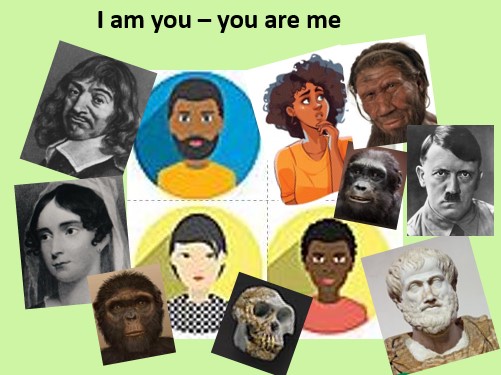
General Introduction to Turing Hominin
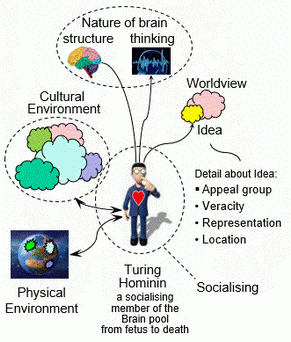
Here a white male geek represents all Turing Hominins past and present, but at ❤
we are all different, just hover over it.
All hearts & brains are alike but skins different, and each of us is influenced by, and contributes to, the Cultural Environment.
This page, along with several others (as illustrated in the adjacent diagram) attempts to model the workings of information processing of a Turing Hominin, here is just one representative of the current (Feb24) 8 billion and the past billions of us.
The main Turing Hominin page gives an overview of the central character and introduces associated topic areas, available via Content Map navigation above that uses a clickable version of this image. The Idea topic is particularly large and is broken down into several sub-pages, see image bullet points, Socialising in comparison is smaller and forms part of the Turing Hominin page.
The Turing Hominin's body and of course brain are part of a Physical and Cultural Environment, and s/he also dwells and abides in social groupings. The brain processes and shares information in the form of Ideas; we process information in a peculiarly human way, but it's special to all of us due to the Nature of our brain and Worldview.
The Physical Environment includes everything around us, including the artefacts of humanity's realised ideas, but in addition some may say a spiritual, or supernatural, environment is also involved, which is discussed in ⮝ What is an Idea - my idea of an idea .
The Cultural Environment includes all the Ideas (clouds) in our brains that are constantly exchanged, updated and recorded as artefacts, including ideas to decode the artefacts' symbolic meaning e.g. language. Cultural ideas were once only recorded in memory, then also physically in simple ways such as clay tablets, and now in a huge array of artefacts.
Our ancestors and their predecessors evolved within this ever changing Physical Environments (represented by star bursts) but over the comparative recent past we've interacted with our own created Cultural Environment, which changes at a dramatically faster rate than the physical one. Our evolution and coevolution with culture is discussed further in ⮝ Turing Hominin
Page summary
- explains the choice of name, acknowledges possible objections and highlights our needs beyond those of other organisms. Introduces evolution and how we came to be as we are, but also our path from birth to death, and discusses the type of brain we use.
Introduces and explains a model of us using an exemplar individual and indicates other pages where various aspects of the model are detailed; but the Socialising element is cover here, including difference between the Cultural and Social environments, and how we pick up and assimilate ideas into our Worldviews
What's here
- General Introduction to Turing Hominin
- Introduction - Why Turing Hominin? :as 12Sep26 08-19
- Dismissive of the Turing part?
- A common narrow view of computers
- Materialist and other views
- Our needs - information, conclusions, socialising
- Evolution and individual development - ontogeny & phylogeny
- Build, maintain and reproduce
- References
- Ontogeny and Phylogeny model
- Ontogeny
- Phylogeny
- More information on evolution
- Brains, minds and consciousness
- Model view of Turing Hominin
- Worldview and Idea - & modeling help
- Modeling help
- The nature of Turin hominin's brain
- Structure
- Thinking
- Cultural Environment
- Physical Environment
- The Sample Human diagram as a data model
- Materialist view - from old Turing Ape
- Summary - agent of the gaps
- Socialising - Turing Hominin is not alone
- The Cultural environment includes
- The Social environment
- Social variety - could we do better?
- Acquiring viruses and ideas
- Hosting viruses or ideas summary
- Walk-through of Catching viruses or ideas
- Catching Ideas, making a collection and Worldview
Introduction - Why Turing Hominin?
The Turing part comes from Alan Turing who is known for his revolutionary ideas on computing around 1936
it's strange to think that only 80 years ago the computer by which you're reading this was just a hypothetical idea. Seven years after Turing's idea Thomas Watson, president of IBM, said in 1943 "I think there is a world market for maybe five computers", but of course when he said "computer," he meant a "vacuum-tube-powered adding machine that's as big as a house". It's fair to say that few people ever wanted one of those, regardless of the size of their desk"- see worst technical predictions. and the Hominin
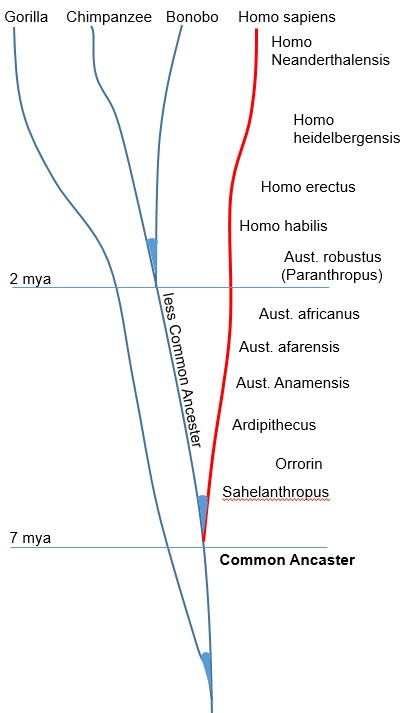
the classification includes all our ancestors since the common ancestor with chimpanzees and bonobos, see ℹ britannica.com diagram.
And from the australian.museum / hominid-and-hominin-whats-the-difference The term ‘hominid’ used to have the same meaning that ‘hominin’ now has, but hominid has been assigned a broader meaning and now refers to all Great Apes i.e. modern humans [hominin], chimpanzees, gorillas and orang-utans plus all their immediate ancestors. ℹ part refers to us and our ancestors going back to a common ancestor around 7 million years ago, as adjacent diagram. This was a very critical event for us and the world: did it start with a combination of opportunity and capability of an individual, which then spread to others who were more adventurous and curious; or perhaps a group that had a special “magical feature” were led or just wondered permanently from the safety of forest; or perhaps they were just driven out and forced to survive or die? - for more {needs writing or deleting} Why we became such a successful species. However it started our resulting ancestral line shows many extinct species, the most recent being the Neanderthals
interbreeding occurred between Neanderthals and early modern humans, resulting in "all modern ethnic groups, other than Africans, carry traces of Neanderthal DNA in their genomes" - Neanderthals, Humans Interbred—First Solid DNA Evidence, National Geographic, 8 May 2010. So our African cousins are pure bred Homo sapiens while the rest of us are mongrels and the last standing version of Hominins is we Homo sapiens.
Originally the name was to be Turing Ape, linking with Desmond Morris’ 1967 book The Naked Ape, but the title implies we are apes without hair. Of course we didn’t evolve from what we see as apes today, but we do share a common ancestor with Chimpanzees and Bonobos (as on the diagram at 7mya) and this ancestor evolved in turn from the ancestor (at the bottom of the diagram) that includes the Gorilla divide encompassing all 3 apes here. Orangutans are also classed as apes and branched off “to the left” even earlier, but we “on the right” are not apes, naked or otherwise. {see ⮝Background and Mechanisms - Where has it gone possibly too detailed diversion}.
I chose Turing instead of Naked in order to distinguish us by our brains and not body hair; to be fair we are similar to apes but without hair, but our brains have made all the difference. Some spark happened at the common ancestor branch 7 mya, as already postulated - happenstance that we left the trees to walk upright and release our hands to enabled dextrous manipulation, sophisticated tools and language, or perhaps wider challenges occurred that helped develop our embryonic feature of mimicking Mimicking (picking up a new behaviour) as opposed to copying (applying natural behaviour) is a special brain feature, for example: although Baboons also enjoy eating termites, and despite watching chimpanzees “fish” for termites, no baboon has been seen to do the same - they just wait for termites to fly out; whereas Chimpanzees will watch and pick up new behaviours from each other, but also from other creatures such as humans? Blue tit bottle pecking . . . . as opposed to copying, or was there a new embryonic feature nurtured, or perhaps a combinations of all, but one way or another, we are here dominating the planet due to our mental capabilities
There's a natural antipathy to comparing our brains to computers (as example below), but Alan Turing defined computing in abstract terms and not constrained to a technology or its complexity - our brain style just happens to be electro chemical consisting of vast networks of neuron cells with electrical connection influenced by neuro-transmitter and other local chemicals. He also formulated the Turing Test that compares an interaction between humans with one between human and artificial computing, a similarity that has come to pass 90 years later. For more on Alan Turing's approach
Although we may not like the mechanistic analysis of our brains, the fact is that a brain can self-examine itself, and in collaboration with other brains, create a realisation of itself in the form of Artificial Inteligence, which is becoming difficult to distinguish from the original. Turing's ideas have become verifiably true via physical world testing. But the brain that is doing this is not significantly different to that of a savanna relative 10 thousand years ago, although today's brain is aided by a massive accumulation of cultural ideas, some of which help the method of thinking. It's taken a very long time to enable this level of self-examination and we happen to be at the end of the single evolutionary lineage, the last stage started about 7 million years ago and developed with the aid of all Hominins - thanks guys.
Dismissive of the Turing part?
Many people dislike taking a materialist approach by aligning us with computing, as in the following example.
A common narrow view of computers
A dialogue between Archbishop Rowan Williams and Professor Richard Dawkins on "The nature of human beings and the question of their ultimate origin" was recorded at Oxford University. During a discussion about the nature of human beings and consciousness Dawkins admits his "test of faith" about a computer that passes the Turing test being conscious - listen adjacent. Following some incredulity by the chairman this led Williams to say that computers are essentially binary whereas we are certainly not. Unfortunately, I don't think Dawkins made the best of the opportunity with his answer - possibly distracted by his self-doubt:
- He mentions the software that achieves whatever a computer does, but not the fact that both computers and brains are binary, computers have semiconductor gates that are either open or closed (not withstanding quantum computers) and we have neurons that fire or not.
- He also didn't mention that we are not comparing like with like. Few of us have any experience of a brain without its mass of peripherals, its eyes, ears, nose, limbs, fingers, touch etc., and its years of experiencing and recording the world second by second with the aid of senses, mobility and manipulation capability. And we too are programmed with our innate behaviours that determine our experiences and responses. It is disingenuous to compare all this to a computer "brain" sitting on a desk experiencing the world thought a keyboard, mouse and printer, although of course a mobile phone experiences the world very differently now and there are sophisticated AI projects using computer controlled robots, and which share the mass of information on the Internet. Even an octopus has a better and more varied life than a desk top computer, but of course they are denied the joys of the Internet - see Data Driven World
We and our fellow creatures are all data driven, and at the very least have sensors to find food and stay out of danger, achieved by processing data and taking appropriate actions. Sensors sense things, or conversely thing data is the input to sensors that subsequently drives processes - we just happen to have the most bells and whistles in the way of processors and a good set of sensors.
We say that we learn by our mistakes and there’s no reason that computers can't too - Turing said at a lecture to the London Mathematical Society on 20 February 1947 “What we want is a machine that can learn from experience", adding that the “possibility of letting the machine alter its own instructions provides the mechanism for this [The Universal Turing Machine]”. With the technology of the time it was only a theoretical idea, but since then it has long been a reality and now in 2026 it has become a very worrying “recursive self-improvement”. However, be it human or computer, both need a core of programmed scripts to establish the scope of the learning, this defines the nature of the beast or system. In our case the core takes the form of our innate behaviours that have been "programmed" over millions of years of evolution.
Materialist and other views
The above comparision of us to computing is Materialist stance and one defined by Wikipedia as:
"a form of philosophical monism that holds that matter is the fundamental substance in nature, and that all things, including mental states and consciousness, are results of material interactions. According to philosophical materialism, mind and consciousness are by-products or epiphenomena of material processes (such as the biochemistry of the human brain and nervous system), without which they cannot exist. This concept directly contrasts with idealism, where mind and consciousness are first-order realities to which matter is subject and material interactions are secondary."
{as IoT Materialism 2019} all explainable by physical stuff
Such a materialistic and de-humanising approach certainly flies in the face of those taking part in Philosophy, Science and the God Debate (Part 1) described as:
"Science disproves the existence of God" - and thanks to high profile scientists - many people unquestioningly believe it. But Oxford Professors John Lennox, Alister McGrath and Keith Ward effectively challenge this widespread belief and show that science and faith in God are not incompatible.
The three participants and Chris Gervais as chairman, discus and try to reach their understanding of the problem. Following a discussion about reductionism and how a conversation can be broken down into its constituent parts, John Lennox expresses his concern that scientific explanations often confuse mechanism with agency and he introduces an example based on a menu and the semiotics the study of signs and symbols as elements of communicative behaviour; the analysis of systems of communication, as language, gestures, or clothing of ‘R O A S T chicken’ - as adjacent audio clip taken starting 1:37:30 into the session - clip transcript - and summary beow:
Lennox starts with a curt explanation of his concern: “Science has discovered a mechanism that does X Y and Z, therefore there’s no God”. He then gives an example of raising his hand, explained in terms of mechanism i.e. of neurons and muscles etc. and also in terms of agent i.e. for the purpose of raising a point, resulting in two different levels of explanation of the same event.
He then recounts a well-rehearsed story of dinner with a very eminent microbiologist who, as a reductionist, believes that everything is explainable in terms of physics and chemistry. Lennox challenges the microbiologist to explain the semiotics, or the way that the letters R O A S T chicken on the menu carry meaning in terms of the physics and chemistry of the paper and ink. Lennox triumphantly recounts that the microbiologist declares that he can’t without the involvement of an agent, however Lennox admits that the argument originated from the Nobel Prize winner Roger Sperry. The chair then suggested that this example could help their discussion and proposes God as being the [ultimate?] agent.
I’m surprised the eminent microbiologist gave up without further discussion and that Lennox finds it so conclusive. Of course it’s just a piece of paper with symbols on it and it has little intrinsic value unless someone, or thing, can make use of the symbols by applying a suitable process. Surely a microbiologist could give a basic mechanistic process explanation, starting with the fact that our brains are electro-chemical and therefore meets his reductionist assertion (electricity being part of physics), and provide a string of processes starting with our optical system sorting out the ink marks on the paper, with higher order bits of brain identifying symbols, language areas realising the meaning and stimulating memories of chickens roasted or otherwise. Is this still mechanistic or is the totality of these complex processes (operating on an electro-chemical brain) the operation of an agent? And perhaps they could go on to discuss what would have happened if the lettering may have been - Μελιτζάνες Τηγανητές - instead (I would choose fried aubergine over roast chicken any day). Or what if they were looking at an old style computer punched card, at best they would what it was, but given the right equipment and software it would have meaning to something and could lead to an output result, but is it an agent? But they didn’t, so no wonder it was a boring evening
Another interesting feature of we humans is our desire to see agency. Viewing the outcome of the mechanisms of Lennox raising his hand, which possibly also involve Libet’s event timings in his brain, is not surprisingly attributed to an agent wanting to raise a point, assuming you understand the social convention of raising a hand. But it is surprising when we attribute agency to the mechanistic movements of triangles and a circle although possibly less surprising when attributed to movements associated with the sea or storms. However, many fires are started by lightning strikes and many animal get roasted, but now we know it’s not the work of an agent, just un-purposed nature.
Possibly "purpose" is the key to all this - this is discussed further in - ⮝In Consequences / repercussions of human strangeness 1. Some of us are happy to accept there's no specific purpose, or value to our lives and to the world; everything is just the lucky result of initial organic life, an evolution algorithm and global events; some natural events are good for us and some not, but there is no absolute value to them or intention. However, many don't agree with this and their worldview includes intention and value to their lives and the world, which in turn requires some form of supernatural overseer.
We all have our worldviews, which are primed by events from birth onwards, and we all have our own unique brain architecture that responds to events in its own way e.g. colour blind, autistic spectrum, musical or mathematical talent. Is a need for purpose introduced by priming and social environment, or is it the result of brain architecture, butsounds a bit like the God gene? Does this relate to my original question: why do intelligent and educated people have such different views about things? - beyond the simple response of: we're all different.
I would say those in the discussion belong to the second category and (at approx. 1:34) McGrath recommends Roy Baumeister’s book Meanings of Life and says: you've got to answer our questions like: Who am I, why am I here?
But perhaps the simple answers are: I'm a human being with a particular worldview and history of events - I’m here due to initial organic life, an evolution algorithm, and global events that culminated in a particular fertilise egg, followed by my history of events – does it have to be any more mysterious?
Returning to Lennox 's original concern: "I think one of the great confusions, and I see it and Dawkins and elsewhere, is there are different levels of explanation which relates to this topic, and very often the argument goes like: science has discovered a mechanism that does X Y and Z and therefore there's no God. That's putting it very crudely and what they're doing is confusing mechanism with agency"
But I’m not sure where it is, that they are confusing mechanism with agency, including the different levels of explanation. Possibly an example is our presents here and that it can now be explained by a mechanistic process of evolution, which no longer needs the extra level of agency. But I take the point of his table experiment, and that an extra level of agency is required in that case.
The originator of Lennox’s argument Roger Sperry was an American neuropsychologist, neurobiologist, cognitive neuroscientist, and Nobel laureate. He also addressed and was recorded at the Proceedings of a Conference on Religion and Science of the National Conference of Catholic Bishops' Committee on Human Values ref. His address was made around the time that behaviourism was being eclipsed in favour cognitive psychology. In his opening remarks he said he renounced his earlier views in favour of a new mentalist paradigm and went on to explain that by the mid-1970s psychology too had reversed its position on consciousness and switched from behaviourism to a new mentalist or cognitivist paradigm.
The criticism of behaviourism was that it was too limiting and didn’t examine mental processes such as those necessary to make sense of a menu, it’s just a more detailed explanation. Lennox's excitement that an agent is necessary to understand a menu doesn’t extrapolate into the world needing an agent; is this just a man (all be it a professor) rationalising his primed wordview. Like McGrath Lennox grew up in Northern Ireland at the time of the troubles and appears to have had a religious upbringing - more on priming ⮝Worldview
{is this helpful - ref e.g. DR. WILSON: To coin a phrase, “Reductionism is the opiate of the scientist.” (p128 onward) - I wanted to try to reconcile the validity of reductionist methodology with the
new holistic, cognitive mode of assembling information and re-creating patters.
Here I attempt to address what these learned gentlemen appear to find so mysterious. At one time the creation of all life on this planet was attributed to a God agency, but now (to some) it's explained by a very workable theory of evolution. I say that the agency necessary to understand the menu is explained by our brain operation, which includes chemistry and physics. Is the end triumph a plea for God agency to be involved in menu understanding as well as universe creation - I'm not sure.
Our needs - information, conclusions, socialising
{too much for Index so moved to here - use as area intro - a look at us TH including brain, mind, consciousness (or not) and examples of our work Imp of human strangeness}
As a species we have done very well, you could say world-class or possibly too well, but never the less as an organic species we still have four major requirements:
- food, water, oxygen, heat and shelter – this is unavoidable for anything that does something, the doing requires fuel of some sort, and being fragile we need shelter from this challenging world.
- sleep - our bodies, but especially our brains, need to be off-line for about a third of the time. No one is sure why, but we all feel and work a lot better for a good nights sleep.
- sex and death – another waste of time is sex and it gets a lot of us into trouble, from judges, bishops to partners. But without the otherwise counterproductive drive for sex there wouldn’t be many of us here. Death is another unavoidable result of doing things, ultimately things wear out, however much you patch them up, and it would be very crowded here without it. An alternative could be to drop the death, sex reproduction bit, but then there would (somehow) be a few, very old people, of the same old style here - all evolution needs death.
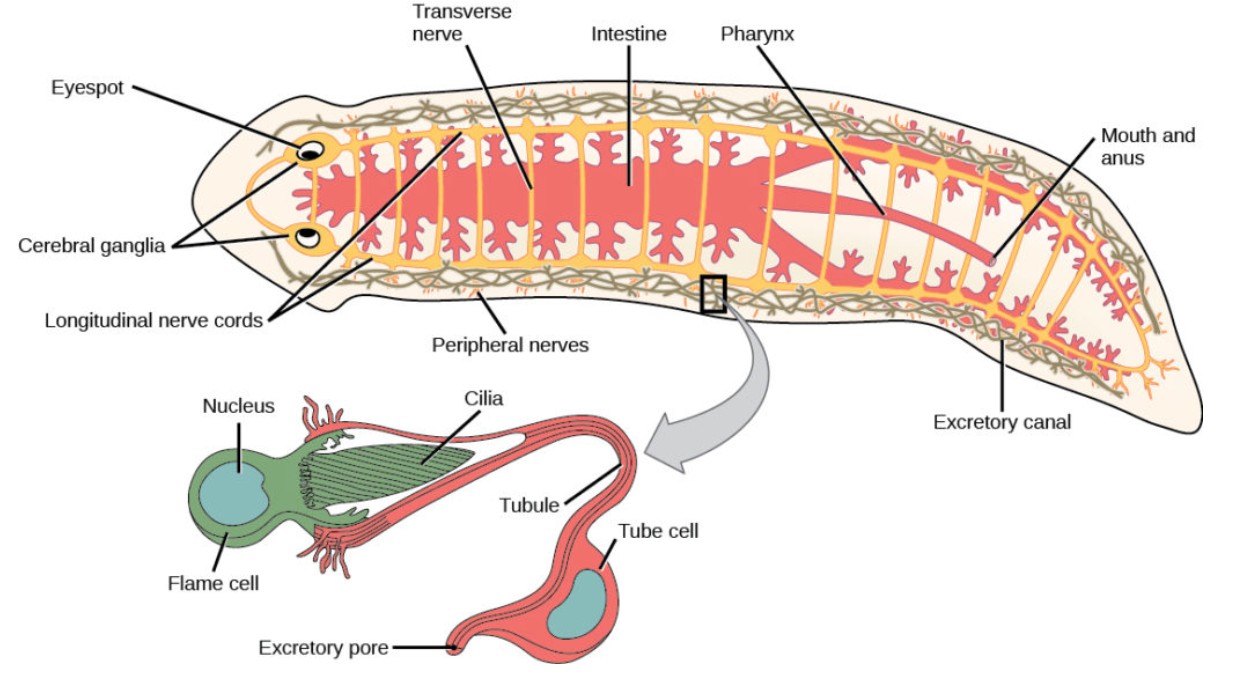
- information – (or in its raw form data) is what all moving creatures need in order to survive, the adjacent planarian is one of the first animals long ago to possess a brain and it was to become the ancestral vertebrate brain; Spriggina is a contender for the very first brain, but is extinct and modern connections uncertain. Planarian have sensors to find food and stay out of danger; sensors sense things, or conversely data is the input to sensors. But sensors aren't much good without a means of moving, and some sort of concluding decision mechanism helps, even if it's "hot - reverse" {my video of toy}. Our decision mechanism consumes vast amounts of data, not just to survive but also to organise our very complex social lives.
The majority of the information here covers the last point about our data processing and highlights both the good and the bad outcomes. Our application of information processing for survival goes way beyond even our ancestors’ sophisticated responses to sensors, possibly too good as there are far too many of us spread across the planet at the moment; and in fact our information processing has evolved into an art (and science) form. Our primate ancestors were generally social and the resultant advantages possibly drove the need for better communication and information processing, however the core capabilities must have been present to enable such expansion. Today’s orangutans are the exception, pretty bright and solitary, but perhaps their brightness is a freeloader of early ancestral sociability. (https://en.wikipedia.org/wiki/Primate_sociality). But ultimately we are a very social species that loves to exchange ideas and information from the trivial to the world shattering, however, the wider organisation of our modern social life is appalling, thanks to our thinking style conclusions and resulting ideas – more on Socialising below.
{drop short summary here, go on to fuller one below} possibly due to: traditional evolution changing to coevolution of brain and data, and then traditional evolution stalling, leaving us now mentally as we were 10,000 years ago – as often said a (stone age – what’s correct term} brain in a modern world {is it 10k?} Recent and ongoing human evolution
OUR NEED 28apr26 - e.g. some like Trump that need suitable ideas streaming in to feed his brain / worldview and resulting egeo, while the rest of us have similar but less visible and with repercusions
Evolution and individual development - ontogeny & phylogeny
This section considers some of our evolutionary history (phylogeny) and our resulting brains, behaviours and ideas, all of which are a consequence of the coevolution of genes and culture, as modeled below. It also considers our individual development (ontogeny) and covers the physical and psychological development from fertilised egg to adult, but here we're focusing on the psychological and in particular ideas acquired, held and perpetuated that all contribute to culture and coevolution.
The evolution of a species is driven by genes, reproduction and the environment, it's a slow and varied process that in most cases ultimately stalls altogether and leads to species extinction. The initial Initial because many factors influence the actual building of a body, the gene plan is a wish-list or ideal plan that may turn out different due to environmental factors – similar to an architects building plan with leeway on specifications of components body style of an individual member of the species is held within their personal collection of genes of particular versions i.e. alleles. The gene collection is known as the genotype and the resulting body the phenotype. The phenotype is a product of both genotype and contemporary environment (genes are potential not destiny), and if considering one aspect of epigenetics possibly past environmental effects too, such as the Dutch Hunger Winter, epigenetics and the winter {should be} are discussed further in ⮝Our Beginnings and Change Mechanisms . And it's the phenotype that is verified as being fit for purpose on the simple premise of surviving long enough to reproduce and thereby contribute its genome to a future generation of creatures. The long term evolutionary history of many many generations of creatures, or a species is its phylogeny.
Build, maintain and reproduce
Many of our body cells are destroyed as we go about our lives, such as outer layers of skin in contact with the physical world, or “the cells lining the gastrointestinal tract must be frequently replaced when constantly ‘worn off’ by the movement of food through the gut”. Body maintenance is achieved by existing cells regularly dividing to replace lost ones, although there’s a limit to the number of divisions and the gene control section keeps a tally, leading to ultimate aging and death {course ref}. In addition to maintenance, cell division enables body growth from embryo to adult, plus extended maintenance in the form of exercise and muscle building. These cells are known as somatic cells and make up the vast majority of the body and they reproduce themselves by dividing in a process known as mitosis, in which two complete sets of genes are copied to the new cell. Gene copying errors can occur naturally, despite processes to check and correct, but genes are also subject to environmental effects such as radiation (ultra violet from the sun, nuclear, microwave etc.) and chemical toxins, which can cause other copying errors - all leading to cell death or cancers. The body’s wellbeing, nourishment etc. also plays a role in good cell replacement.
In addition to somatic cells there's another type reserved for reproduction, known as germline cells. Whereas somatic cells all contain two sets of chromosomes, each holding the individual's complete set of genes (genome, and somatics proliferate by division via mitosis, germline cells ultimately produce mature cells containing only one set of chromosomes via meiosis cell division. Initially, meiosis operates on cells derived from primordial germ cells that appear in the very early stages of embryonic development and contain two sets of chromosomes, and:
- In females, meiosis starts on these primordial germ cells while the female is still a foetus inside the womb to create millions of incomplete meiotic cells, known as primary oocytes. A female is born with this lifelong pool of primary oocytes, and meiosis only completes on one egg at a time during each monthly menstrual cycle after puberty.
- In males, the primordial germ cells migrate to the walls of the testes' internal tubules where they change into spermatogonia cells and remain dormant throughout childhood. Once puberty hits, these spermatogonia continuously divide by mitosis to maintain the stem cell pool, and then constantly switch into meiosis to create millions of new sperm cells every single day for the rest of their lives.
During mating one female and one male germline cell, matured from puberty onwards as explained above, combine to form a single zygote cell, which now contains two sets of chromosomes in a new combination; the zygote then continues to divide in somatic style forming an embryo, how it does this is another fascinating story. This embryo soon develops a new set of primordial germ cells in the very early stages of embryonic development; because these 40–50 initial cells hold the new genetic code combination for the embryo's future off-spring, they are protected in a virtual virtual as mammals and reptiles achieve protection by temporarily place them outside the developing embryo, while many invertebrates use a different strategy for primordial germ cells, and their cells to remain in the embryo biological vault to avoid accidental corruption while the intense cellular activity of building the embryo takes place. Once the developing reproductive organs exit the virtual vault is opened, either inside the womb to set up the lifetime pool of eggs, or in the testes as dormant stem cells giving rise to an endless supply of sperm.
The mechanism of keeping the germline cells separate from somatic ones is an essential feature of evolution and is the reason that Lamarck’s inherited characteristics doesn’t happen. The somatic cells are part of the individuals life long history e.g. cells related to a black-smith father’s big muscles, or skin melanomas. The germline cells are kept well away from the knocks and disasters of life and are ready to create new “clean” offspring. However, germline cells can still be influenced by radiation or toxic chemicals and another mechanism that affect evolution is epigenetics – over or outside genetics and the traditional DNA-sequence-based mechanism of inheritance, a prime example is the Dutch Hunger Winter.
References
- e book - Cell division is a common phenomenon that occurs in all living entities, except for cells that have completed somatic differentiation
- Mitosis, Meiosis, and Inheritance
- Introduction: Cell Division and Reproduction
Ontogeny and Phylogeny model
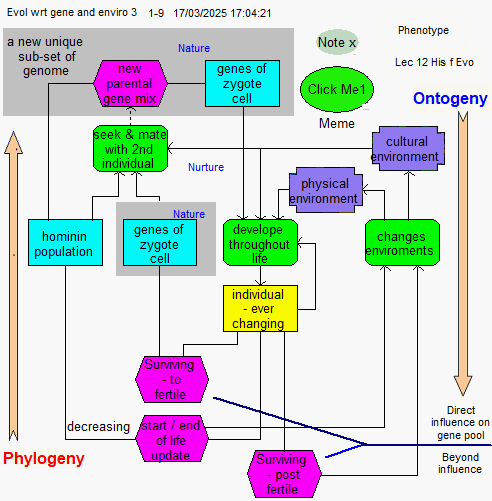
Ontogeny
- starting with a new individual in the form of “genes of zygote cell” that is the fertilised cell, which becomes an embryo, foetus and the individual who continues to “develop throughout life” and is an “individual – (who is) ever changing”. There are 4 major milestone events in their life:
- the 1st and 2nd are combined as the “start / end of life update” event that feeds into one of the “hominin populations” as they join and inevitably leave the population
- The 3rd is critical for evolution and is “surviving - to fertile” thereby passing the fit-for-purpose test and qualifying to pass on their genes to another generation, if they want to - a more recent option both physically and socially
- The 4th is still “surviving - post fertile”, which from a direct evolutionary view is a waste of space and resources, however, in our sophisticated society grandparents play a big role in helping the development and survival of their long ago contributed genes; this age group also often make important, but not always good, contributions to the “cultural environment” and “physical environment” via inputs to “change environments” {NB name change}
Phylogeny
- a species' evolutionary history is caused by a cascade of individuals, in this case the ever changing “hominin populations”, which is influenced by the “physical environment” in the form of food, shelter, climate and physical boundaries such as rivers and mountains that may establish separate populations; together with the population’s gene pool of current fertile individuals within that population. A key feature of the evolutionary process is “seek & mate with 2nd individual” with an input from “cultural environment” – it’s key for several reasons:
- natural mate selection and in our case: males looking for healthy and attractive offspring producer(s) and females looking in addition for a long-term provider for the offspring for which she at least will be caring
- we have many cultural influences such as: the wrong / right family, social class, religion or ethnic origin etc., which may or not conflict with individuals preference’s, all of which change over time in line with social views
- the availability of contraception, which isolates the desire for mating from the consequences, and other possible social controls such as eugenics and medical interventions
- social attitudes: once it was an expected duty to have children, and still is a necessity in some societies to provide a family labour force, or in extreme religions to increase membership numbers, but generally such assumptions are now challenged in favour of attractive alternatives to having a family, and there’s even a moral argument when considering the prospects of future generations in a world climate that’s hostile to us
The result of “seek & mate with 2nd individual” is an event of a “new parental gene mix” in the form of “genes of zygote cell” - the fertilised cell that becomes an embryo, foetus and a new individual based on a unique set of genes, unless its two individuals based on a splitting zygote cell i.e. monozygotic twins. Multiple splitting is also possible giving identical triplets, but multiple births are usually dizygotic i.e. multiple zygote cells, but combinations of both are even possible ref.
As billions of these cycles occur in parallel over millions of years, the inevitable changes in the physical environment influence the fit-for-purpose criteria, thereby selecting and promoting different phenotype features, as these are generated by the genotypes the genes become selected. The physical environment also changes such that a species group can become isolated and their “hominin population” and “gene pool” becomes independent and can develop into a new species, and given enough time if ever reunited with the original group they are no longer able to breed together {why?}. Alternatively a species group may voluntarily isolate themselves by travelling to far-off lands where the grass may be greener. Other voluntary or self-imposed influences come from the cultural ideas to which we expose and dictate to ourselves.
More information on evolution
- for some general information about evolution see footnote Chat about evolution 𝙵
Brains, minds and consciousness
Returning to our phylogeny and the brain of which we are so proud. Long ago (385 mya?) during our evolutionary path to world domination our potential placental ancestors and the marsupials quietly evolved, waiting in the wings for the big guy domination to end, luckily for us if not for them. At this point brains are not surprisingly termed reptilian and this is the foundation of ours and kangaroos et al, more in ⮝Our Beginnings and Change Mechanisms and the Tree of Life diagram and The functional and anatomical organization of marsupial neocortex: Evidence for parallel evolution across mammals. And also The reptilian brain with good dia
Evolution continued to added more bells and whistles to the more successful mammal line. This growing set of features eventually arrived at our common ancestor with Chimps and Bonobos, but we branched off into Hominins and evolution added dramatically more features to create many Hominin trial versions, which all fell extinct on the way to our emergence and domination.
This domination involved a lot of thinking, which is obviously governed by the nature and capabilities of the brain doing the thinking process, but also the nature of the information feeding the process. There's little we can do about the processor, it's what has taken millions of years to evolve, or as some may say given by God. This brain may be continuing its evolution, but not noticeably for the last 150,000 years - a very short period in evolutionary time scale, but never the less long enough for some evolutionary changes in last 10k yrs. Possibly brain selection pressures have been over been overtaken and muddied by other events, such as our medical abilities? The other component, the information, is however an open canvass and has and is totally muddying the waters – we even have alternative facts now.
We are familiar with: thoughts, emotions, memories, dreams etc. that all lead to, for example, a sense of justice, hypocrisy and empathy, but to what extent did these exist in earlier brains during the long journey to us? We are also aware of them as a grand joined up production, which we hopefully enjoy as our daily lives unfold, and all of which is labelled I and my day. Or is the notion of I just the result of the combined features of a complex brain in operation (otherwise known as the mind) and the inevitability of a very complex system - an epiphenomenon? All this must have started to happen bit by bit at some time long ago too, there was no magic wand waived over one of our mammalian ancestors. Or was there a special moment, such as the once in a world lifetime event when one cell consumed another leading to mitochondria fuelled eukaryotic cells, the fateful endosymbiosis more than 1.45 billion years ago. Or perhaps there was a wand moment in the form of an evolutionary mutation spark that evolved into conciseness, or what was once considered the soul - but I prefer epiphenomenon.
LOTS MOVED TO THINKING AND SOME TO IDEA 10NOV25
Model view of Turing Hominin
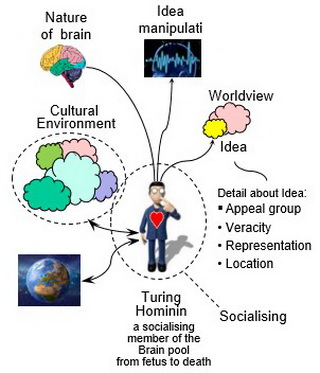
Returning to the familiar adjacent General Introduction diagram and our relationship to the world and to each other. The exemplar individual, or sample human, has their own personal Nature or style of Brain that holds the Worldview of Ideas, which are influenced by, and contributing to, the Cultural and Physical Environments aided by Socialising. The various elements of the diagram are introduced below but expanded in their own pages, except Socialising that’s cover here. This summary diagram is also expanded below as a large data model describing what is happening, but how it happens is another story covered in different process type models. This model represents my view of what is happening to us in terms of data and process, or how we think about ideas, it may be wrong or incomplete, but it is a starting point.
Worldview and Idea - & modeling help
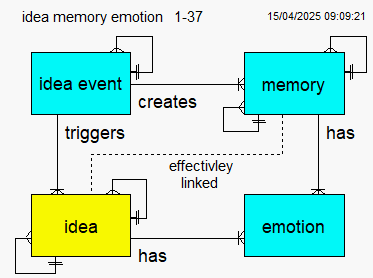
Although there are many marvellous things occurring inside our brains there are three of particular interest here: ideas, memories and emotions all of which link together and are instigated by events, as adjacent model.
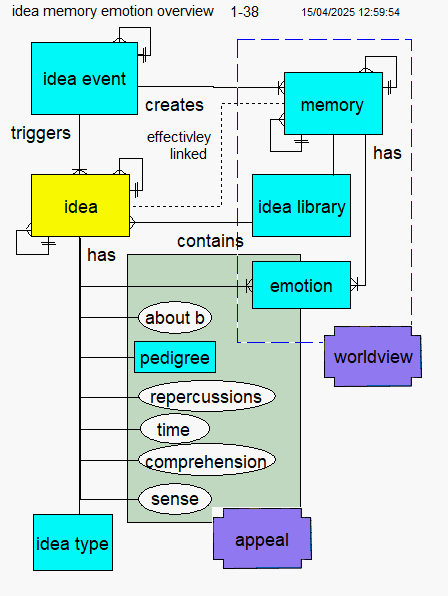
These 3 things, or entities, turn up in various places here and are incorporated into different views, for example the second adjacent model. Here an Idea is shown in more detail and includes a group of items called Appeal, which includes Emotion as explained further in ⮝Turing Hominin > Idea . A representation of Worldview is also shown that’s primarily a collection, or library, of Ideas but also Memories that also have Emotions, see ⮝Turing Hominin > Worldview for more detail.
Modeling help
These data models show the relationship between things (i.e. what is happening, how it happens is given in process models) and some things can, for convenience, be grouped together and given a name, such as the Appeal and Worldview groups, and an entity such as Emotion can belong to more than one group. An example of this appears in the big data model below in the top left hand corner.
Obviously all these items can appear in many models and even more than once in the same model to simplify the drawing, as for example Idea in the big data model below. But wherever they appear they are the same thing with the same relationships, so the second Idea towards the bottom still has the same relationships as the top one, but here it also indicates that the “culture idea library” or Cultural Environment “consists of” many “ideas”, which also applies to the top appearance but again not shown for drawing simplicity. To help keep track of an items total relationships, or actions in the case of processes, various matrixes are included in ⮝All models and matrices WHAT ABOUT SPIDER STYLE DIAGRAMS FOR KEY ITEMS?.
Finally to complete the description “idea type” refers primarily to whether an idea has been realised into the world, or is in a brain, and additionally ideas are further classified by their level of veracity.
The nature of Turin hominin's brain
Structure
The above hopfully provides some justification for considering the brain in computing terms. This is continued in The nature of our brain {or whatever its to be called in new arrangement e.g. TA's brain nature} in terms of the brain's architecture i.e. the various physical areas (or more correctly volumes), what they do and how they interact. We could easily have a very different style of brain, but the one we have, evolved to keep us going in our environmet about 100 thousand years ago {check date} and for the millenia leading to that time - see {whatever area 4 section it is}.
Thinking
- having considered the architecture the next stage is to consider how it works and what the component parts do and interact. The prime role of our the brain is to monitor the world and enable us to: keep out of danger, and take suitable opportunities as they arise, or inspire us to go looking for them - in our ancestral past that was the only role. This is the basic survival brain feature that most animals have, it works well for us and we're often not aware of it. The estimation of the approaching traffic's speed verses our crossing time is pretty complex, and the instinctive fast response to an incoming flying object is very useful too - we also co-opted it to ride bikes and play the piano too.
However, for various reasons our brains have an additional feature. An easy speculation is that once we were fed, watered and safe for the night rather than just sleeping we started thinking {ref to something saying we think rather than sleep}. Possibly initially thinking and planning the practicalities of a next day's hunt(a development of 'inspire us to go looking for them'), but latter less tangible things, possibly based on the immense sky above, or why trees wave around at times. This brain feature enables us to reflect upon things including itself, or simply self reflection.
The ability to reflect upon one self, or anything else, gives an awareness of the subject that can be sustained and re-visited at will whenever we want; this contrasts to just responding to an event and then moving on to the next event. This reflection ability is part of what we call consciousness - this too is touched on in self reflect.
Cultural Environment
A single Turin hominin is very impresive, but with at least 7.5 billion of us (today's figure) - OR - more positive interacting with our primative self interests and world affecting abilities, it gets very scary.
We each bring to the world our brains that are filled with various ideas that are then either re-cycled, possibly with some value add or personal spin, but even if reiterated verbatum it has the effect of perpetuating that idea, be it a good or bad one, and of course who is to say if it's good or bad. And thanks to or ability to record ideas its not just the current 7.5 billion contributions it the past membershp that is current ly estimated at 108 billion. Of course not all our ancestors recorded their ideas and even with the internet there's not 100% interconnection between us all today but there's still a masive pool of human ideas. An attempt to cover all the effects of this is in socialising
Physical Environment
WORDS FROM PYS ENVIRO STARTING POINT This is the physical environment of us Turing Hominins that challenges and supports us; it includes: food, shelter, animals, other humans, forests, mountains, oceans, viruses, bacterial, weather and changing climate, sunsets, thunder storms, the night sky and more recently artifacts of our ideas from pots, books to nuclear waste. Our ancestors, and their predecessors, slowly evolved within this ever changing environment, which was created and is maintained by biological and other physical influences. However, during comparative recent history (50 to 100 mya?) we have interacted with our own creations under the influence of our Cultural Environment, which likewise changes, but at a very much faster rate.
The Sample Human diagram as a data model
To make things understandable we often break things up, but in doing so we can then lose sight of how they inter-relate and the following rather large and complex data model is an attempt to correct this. For simplicity the diagram only includes the Nature of brain and Idea manipulation in summary form because:
- Although the nature of particular brain instance certainly affects the specifics of this diagram, the diagram is covering the generalities of our interactions with each other and the world. The Nature of a brain affects how an instance of the ever changing individual behaves, but not the general outcome.
- Likewise Idea manipulation attempts to show how we exchange ideas within ourselves (thinking) and with each other in general, and again any one instance doesn’t alter the overview, also the diagram is of a different style, it’s a process model that describes how thing happen and does not integrate with the overview data model.
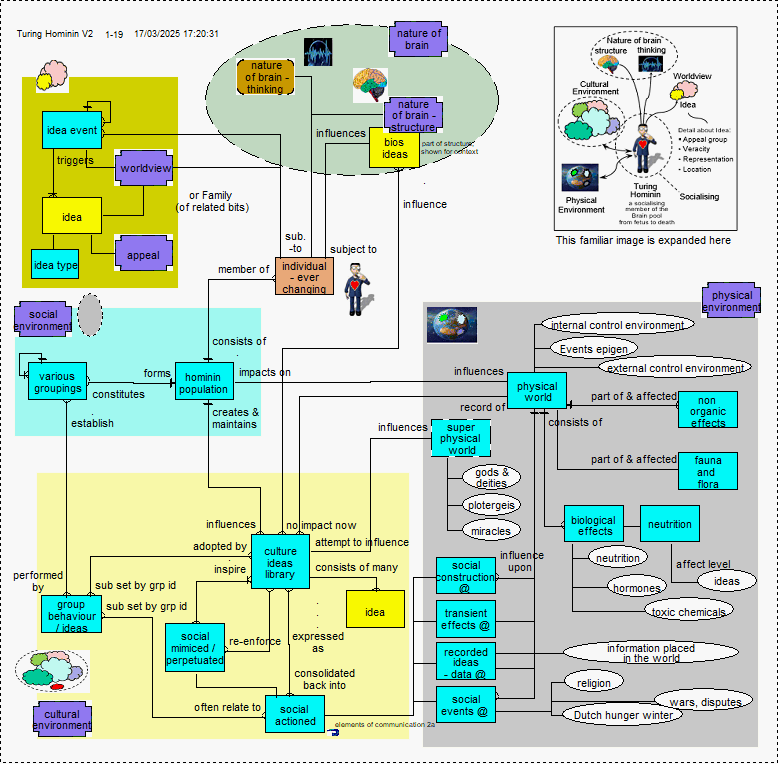
{remove “is being” from dia – extend Dutch Hunger Winter to Tim Spector bio-gut epigenetics here and evo models}
{need pigs-ear Hom. Pop. as it talks to itself / idea exchange??; - was g0145401.gif}
{need pigs-ear Hom. Pop. as it talks to itself / idea exchange??; - was g0145401.gif}
drop dotted border
For a copy of the data model in new window click
For {fancy} copy of the data model in new window click
The "individual - ever changing" or thinking Turing Hominin has "idea"s that may become part of a "worldview", as top left of the diagram (lines just pass through "nature of brain", and “idea” is shown outside “Worldview” for clarity); the "nature of brain" belonging to a particular person is expanded in other models.
As all the 8 billion of us, this individual is a member of the [social environment] that consists of the "hominin population", which breaks down into "various groupings" based on, for example: geography (country, city etc.); family and tribes; interests and possibly religion. The "various groupings" determine the other individuals with whom this individual gains and exchanges ideas, in the form of [cultural environment] and "group behaviour / ideas" - together this completes this individual’s social environment.
{orig}Like the 8 billion of us, this individual is a member of the "hominin population", who form "various groupings" based on geography (country, city etc.), family and tribes, interests and possibly religion - that combine to form our "social environment". The actions and ideas or the "group behaviour / ideas" of the "various groupings" se "various groupings" determine a person’s social environment and the individuals with whom they gain and exchange ideas i.e. "group behaviour / ideas"; once probably just face-to-face within a village, but now extended across the world really and virtually. This exchange of ideas making up the [cultural environment] was once, for example, just face-to-face within a village, but now extends across the world really and virtually.
The [cultural environment], which includes “cultural ideas library”, has been created by the many individuals of the “hominin population” past and present and consists of their many “idea”s. All of these cultural ideas have been realised or [social actioned] in some way, if not they are still sitting privately in someone’s head, or died long ago with the person. Actions may be: written, drawn or objects made possibly thousands of years ago or yesterday, spoken and perhaps recorded, resulted in historical events such as wars, or those now leading to climate change, but if inconsequential or unrecorded they are lost for ever. Which ideas and how they are actioned is influenced by “group behaviour / ideas” and also “social mimicked / perpetuated” {correct ARIS spelling}. The “social mimicked / perpetuated” ideas relate to the idea of memes, where such ideas have a lot of Appeal (see xx) and are probably perpetuated more on their Appeal than merit.
{orig}The hominin population, past and present, has generated many ideas that are represented by cultural ideas. These ideas take the same form as those shown for an individual on the left (structure, appeal, and type - see xx), after all the cultural ideas are only the aggregate of all individuals’ ideas. All of these cultural ideas have been realised in some way (if not they are still sitting privately in someone’s head), some may be written, drawn or object made possibly thousands of years ago, or yesterday, some may have been spoken and perhaps recorded, or some may result in historical events such as wars, or those now leading to climate change. However some ideas if not impacted or recorded are lost for ever.
The [physical Environment] {update model to include new bit of phys enviro showing super phys world with attributes} includes the “physical world” that influences us, and at a minimum gives us a home and it's also home to all other “fauna & flora” {change of name from “species populations non-human”}. It follows that the earth with all its occupants has “biological effects” on us e.g. “nutrition” “poisons” “bacteria” and also “non-organic effects” e.g. weather, volcanoes, radiation, chemicals (natural or man-made).
The earth is also the platform on which we realise our ideas, or turn them into something tangible for other to notice. This realisation or “social actioned” may be by an individual's idea e.g. a Banksy Mural or a group's collective set of ideas e.g. a riot. The realisation can take the form of a:{where how to pack this in tighter}
- "social construction” e.g. building, open-pit mining such as Bingham Canyon, or individual clay pot
- “transient affects” e.g. a smile, clapping, a conversation
- “recorded ideas – data” e.g. films, speeches, experimental results, atmospheric / weather data (not directly our ideaa, but a record of the idea that we needed it, similar to an experiment)
- “social events” e.g. concerts, protests, wars, many of which are recorded (so included as above) formally or on personal phones
These realised ideas are (or were momentarily) all in the world somewhere: standing on the surface, in a museum, library, once live on a theatre stage, etc. but now usually also in a data centre somewhere. Which returns us to “physical world” that influences us, not only giving us a home, but also a wealth of recorded ideas that form the "culture ideas library".
Finally as part of this physical world there’s a super physical world shown {top left, move down} with a dotted outline – does it actually exist or is it just a figment of our ideas? It certainly influences and affects {doesnt link need to go to cult lib} us and we attempt to influence it with gifts and promises, but again is there anything real here, and anything beyond our cultural ideas on the subject.
The world together with all its fauna and flora exists with or without us, but for the last few million years it has been the recipient of all the ideas that we have realised. Many ideas have been benign, such as taking clay from the ground and baking it into pots, but taking uranium for nuclear power and leaving the waste is not so begin, likewise filling the atmosphere with extra carbon dioxide is not such a good idea after all.
Having wars or pandemics amongst ourselves is of little interest to the world (although a possible benefit to it), but destroying its fauna and flora can be seen as a bit selfish. However, drawing pictures on cave walls, or clay tablets with symbols isn't so bad; and, although consuming resources, plastic disks with coded symbols, or even mighty machines storing billions of coded symbols, isn't so bad when considering the necessity of recording all our brilliant ideas.
Materialist view - from old Turing Ape
{already done above - anything new here?
So having de-humanised us into a mere robot let’s take some more steps in the reduction, or reverse engineering of us. Five sections follow that introduce separate topics (as adjacent diagram) all relating to my ultimate reduction of us into processors of information who crucially are also mobile builders. Processing includes the information available in the form of ideas shared with other brains, the brain that does its quirky processing of ideas, the accumulated ideas of humanity as captured in a Cultural Environment and all contained in a Physical Environment enabling our movement and building - or simply: ideas, how we formulate and communicate them, and the effect that they have on us and the world.
{good bit to include - the data environment by way of connection to other brains and their ideas that belong to the present and past (society & culture)}.
Summary - agent of the gaps
{if include here need to re order to same as above }
- The Turing hominin or more kindly 'thoughtful person'
 the symbol used, for better or worse, is a traditional western white man, please mentally substitute as necessary - also need some ancestors
has ideas (yellow cloud) that are discussed in What is an idea
the symbol used, for better or worse, is a traditional western white man, please mentally substitute as necessary - also need some ancestors
has ideas (yellow cloud) that are discussed in What is an idea - these ideas are formulated by that person's brain, the nature of which is described in The nature of our brain
- how that brain manipulates these ideas is discussed in Self reflecting mind
- and the many clouds on the left represent the accumulated collection of ideas within our societies and cultures and their repercussions on us is discussed in Socialising and Culture.
Summary {as in Common bit - different & better, delete above?} The Turing Hominin has a body and brain that is part of a Physical and Cultural Environment. The brain processes and shares information in the form of ideas; we process information in a peculiarly human way, but it's special to all of us due to our brain nature and worldview.
{ How have we become, (Can we ever think straight - possible include in Self Ref;
Why do intelligent / Why so different - in Implications and hum strang area) - see static graph index }
END BROUGHT UP
(is Hominin still correct? - ideas include those to help development and troubled by Covid lock down, anls James feeling based intention & idea emotional like - all to go somewhere}
{for Socialising bit – after nightie at Wayside 15sep23 - 2 levels: ancient male worrier + attractive breeder, additional level now of equality - more to life than survival}
A big advantage of living in close social groups is that it enables idea sharing and the development of a culture, be it based on aggression, love, or bit of both. Once we're ejected into the world our brains start their lifelong filling of ideas and encouraged by those around us. Initially socialising is with our mothers, but quickly extends to wider family, then teachers, possibly religious leaders, friends, employers, work mates etc. Many ideas are picked up, some formally taught as truths, while others are acquired because they appeal to us, leaving the un-appealing ones to pass by unnoticed, but how many superficially un-appealing ones penetrate subconsciously and subsequently influence our thinking? Socialising is obviously a two way exchange of ideas and not only do we pick up ideas, we reiterate them, with or without our value add or adaptations.
The Model view of Turing Hominin and The Sample Human diagram as a data model above include both Social and Cultural Environments and the difference between the two, as used here, is described below for clarity:
The Cultural environment includes
- All the ideas we humans have ever had and which are available for others to understand. At one time ideas within a particular culture were relatively local to a tribe, village or region etc., but now thanks to the Internet all ideas are available to anyone who can connect to it. Here culture is the collection of ideas, whether people follow those belonging to a particular culture is a different matter.
- Generally ideas are recorded in some form, possibly directly as practical objects that may represent ideas behind its creation, or by symbols that represent or convey ideas and include books and visual images presented via a variety of technology today.
- Other ideas may be given as performances such as speeches, storytelling in plays, films or round camp fires and may include additional symbolism, or ideas behind ceremonies and other gatherings or events. All these performance ideas may be fleeting and only appreciated by the audience at the time or recorder for transfer to others.
The Social environment
The Sample Human data model above shows the social environment as including "human populations" and "various groupings". During evolution and early social lives individuals didn’t have much choice about belonging to a particular population or group, and so concentrated the mind of evolution, but now there are few boundaries left as many of us travel the world and we even have social media in addition to multiple physical groups to choose from, but nevertheless we still tend to stick to social norms such as national identities.
Regardless of personal movements populations can still be classed as countries or areas that introduce particular circumstances, for example the Inuits of Alaska, with the Iñupiat in the north relying on hunting and fishing for survival, and the Yupik in southwest. And more specifically a few remote tribes actively seeking to remain isolated to maintain their unique cultural identities and self-sufficiency, along with disease immunity as contact can cause epidemics decimating or entirely wipe out their populations (a traditional evolutionary mechanism), not to mention changes to social grouping by missionary groups attempting religious conversion. There’s currently a polarisation of nationalistic feeling encouraged by far right politics often leading to an aggressive desire for power and a tendency to put one's nation's interests above all others.
Social groups can be summarised as containing:
- people such as: family, educationists, friends, club members, workplace colleagues etc. all leading to an interchange of ideas.
- individualss roles, status, and position in a hierarchy.
- physical groups such as: jobs, trades, professions, entertainers, service providers, armies, clubs.
- social domains ᚜Not by genes alone - How culture transformed human evolution 15 p156 ᚛ However, much evidence indicates that parents play at best a minor role in many domains in determining the ?nal cultural variants their children adopt. Behavior genetic studies indicate that most of the similarity between the personality traits of parents and children is due to genetic inheritance, not vertical cultural transmission - - BIOS? P156: ethnic background, religion, politics, social media groups, sports - gambling, finance – investment, bills etc. 16apr22 wrt NBGA
Social variety - could we do better?
One of the key reasons for our success is that we are a social species, in a similar way to our closes evolutionary cousins the chimpanzees and bonobos. All our styles of sociability grew from the features of our shared common ancestor 5 to 7 million years ago, as already shown. Interestingly, a different style of social life evolved some 2 million years ago when a group of “less common ancestors” became isolated by the Congo River - possibly geological changes turned a previous stream into a mighty river. This isolated group evolved to become today’s separate species of Bonobo.
There's a very notable difference in the life styles of those who continued to become today's chimpanzees and bonobos. Bonobos use sex freely to calm aggression and maintain an equitable "make love not war" social style, whereas male chimpanzees use aggression to compete for dominance and rank, and to obtain sex, leading to a generally aggressive and violent society - The bonobo genome compared with the chimpanzee and human genomes.
These different social styles may remind us of something, and the article referenced above says: “Thus, chimpanzees and bonobos each possess certain characteristics that are more similar to human traits than they are to one another’s". It follows that the ingredients for the two social styles, which we share with chimps and bonobos, were present in our joint common ancestor 5 to 7 million years ago; however, our ancestors possibly didn’t have the “safe space” opportunity to develop the separate “make love not war” species. Our hominin line has many species that became extinct and an embryonic non-aggressive version would not have lasted long in the evolutionary competition of 'Nature, Red in Tooth and Claw' as we evolved towards world dominance. But are the remnants still there as seen in the Flower Power movement of the 1960s and 70s in a relatively safe social environment?
However, as we now enjoy being the dominant species, safe from external competition and 'Nature, Red in Tooth and Claw' , and notwithstanding bacteria and viruses that our technology can overcome, it would be good if we could stop competing among ourselves and release our inner bonobo. But as a consequence of our moving from biological Darwinian evolution, to a coevolution influenced and driven by a cultural evolution, is this now impossible? This change has happened over the last million or so years, were the rules of selection criteria have changed from simple physical survival of the fittest for purpose, to the survival of the culturally dominant, but still based on our inbuilt evolutionary success features of: family and tribe first, enforced by sophisticated social organisation including aggression and violence?
Let’s assume that the above change from biological Darwinian evolution to a cultural evolution was peculiar and integral to the Hominin branch; and that the “less common ancestors” branch continued in a more traditional Darwinian style. So when the opportunity arose from potential bonobo isolation in a safe environment they were able to embrace and establish a gentler equitable society. They arrived in a safe place with a mind still open about how a society could be without external pressures. The Flower Power movement, epitomised by John Lennon's – Imagine song, was an attempt at a bonobo society but doomed to fail against so many other self-interests, but (or and) would our advance world of today be possible in such a fanciful society. Perhaps a good compromise is achievable by a change of what we value as described by Mariana Mazzucato in ᚜The Value of Everything - Making and Taking in the Global Economy 17 ᚛ click . But possibly the ultimate challenge lies in wait, and unless we can put aside our internal aggression and co-operate, and although we're the dominant species, we will again face 'Nature, Red in Tooth and Claw' in the form of irreversible climate change.
A different approach to an alternative society is also discussed in ⮝Social Darwinism, attitudes & an Alternative Society
~ ~ ~ ~ ~ ~ ~ ~ ~ ~ ~ ~ ~ ~ ~ ~ ~ ~
{22oct22 - how about a Group / social thinking section – we individually think (in my simplified suggestion) by shuffling and comparing our ideas and coming to a concluding one, and we do a similar thinking jointly as a society. But when thinking alone it is often hard, it needs concentration to make a reasoned argument and may take several shuffle / conclusion cycles to arrive at what we may think is a reasonable conclusion – beware the rational conclusion, which is aligning the argument with our worldview rather than any verifiable facts.
However thinking as a group to arrive at a concussion is fraught with more problems. At best it may be under strict rules and procedures such as a court, and to some extent in a parliamentary debate or with less constraint in a committee discussion. But even here under rules individual non-reasoned prejudices come into play, and once in general public “conversations” anything goes . . . . end 22oct for now}
.. https://www.merriam-webster.com/words-at-play/deduction-vs-induction-vs-abduction ..
Acquiring viruses and ideas
There are certainly a lot of us and we usually don't like to be alone, although we do all like a bit of personal space from time to time. At one time we only interacted with members of our tribe or village, but of course now we mix globally, although technology, media and the Internet has enabled mental interaction without the need for travel. And all this socialising obviously results in exchanging ideas, be they important life changing ones, or polite social grooming or gossip. These exchanges create fleeting ideas, but if considered important may be recorded so as not to be forgotten – perhaps an appointment date and time, or a brilliant idea etc. This introduces the two aspects of Cultural Environment, the recorded ideas for off-line consideration and the fleeting real-time ideas that never-the-less stick in our personal idea library and contribute to our feelings about ideas – but is social media taking over from this?
Our socialising may be good for spreading ideas but it’s also good for spreading many infectious diseases, some of which are fatal, and which originate by our socialising with or eating animals. Due to our now supper socialising and the resulting devastation of Covid-19 has required a reversal of much of this socialising in the short and probably long term, which in turn has severely disrupted our mental wellbeing and our socially based financial system. Fortunately serious pandemics are not common, but there is a worrying parallel This may raise alarm bells with some about: memes, Richard Dawkins and religious people's brains having viruses. There was understandable indignation due to misinterpretation of the wider idea of memes, which I hope to some extent put right here. with ideas as discussed below.
On the other side of the sword are the advantages enabled by socialising, we have created many institutions such as: a health system (very helpful with pandemics), a financial system (susceptible to pandemics) that relies on socialising and consumption of goods and services, education systems, law and enforcement systems and even governance and leadership. We’ve also created entertainment institutions giving cinema, concerts and sports etc. and socialising venues such as pubs, cafes and restaurants.
We’ve built all these institutions and functions of society by creating and exchanging ideas. Although much of our idea exchange is just being nice to each other, showing that we care and is general chit-chat, there is of course the serious stuff too, which has enabled us to build these institutions and functions of society. The collection of all these ideas spanning the millennia and globe is represented here as our Cultural Environment.
Unfortunately idea exchange is subject to "pandemic" too, where ideas are just automatically replicated and passed on. Slogans such as "make America great again", "get Brexit done" or "black lives matter" are obvious examples; propaganda campaigns (see cc) are a little more subtle and then there’s more insidious campaigns, which have been enhanced by modern communication starting with the printing press, with targeted messaging, be it marketing or political Although a slogan adding “black lives matter” worried me, the others slogans, propaganda campaigns and targeted messaging are not necessarily desirable objectives. It is often asked why are these sophisticated social manipulation not used for good.. But fortunately there is a vaccine in the form of education, not only does it enable the creation of socially constructive ideas, but also inspires a challenge to the “viral” ideas to prevent blind replication or action. Education is integral to our Worldview as discussed xx.
Other than military viruses created as weapons, viruses just happen and we suffer the consequences, if any - we don't notice the ones we easily cope with, but we defiantly create all ideas. Some ideas are good for society, while others are just comforting, but some are malevolent and only serve the causes of individuals or groups, and are deliberately broadcast and designed for natural spreading. One easy way to deliberately spread an idea by natural means is to invoke nationalism, some examples being: Adolf Hitler's rise to power around 1933, Slobodan Miloševic xxx, UK Brexit "take back control" and US Presidential "make America great again" - all of which had serious down-sides and not of general benefit. Others ideas have inherent natural appeal (rather than designed) and so spread naturally without any (or little) deliberate orchestration, such as: religions, folded toilet roll paper …..
Hosting viruses or ideas summary
Hosting viruses or ideas - we host viruses within our bodies where they multiply and we release them to the world possibly by coughing or sneezing. The virus may float in the air waiting to be breathed in or lands on a surface waiting to be picked up from there. In the case of ideas, we hold them in our brains and release them into the world by our actions and one may immediately be observed, or recorded to be picked up later.
However, while we release many copies of the same virus, we only release a single version of an idea, but we love to exchange ideas and so spread them, especially when they Appealing to our Worldwies, even if malicious, destructive and untrue. And just as viruses can mutate to widen their net, so can ideas. We may just repeat an appealing idea verbatim, or add our own spin that may make it even more appealing and possibly to a different audience
We can limit the spread of viruses by vaccines that reduce or eliminate the onward transmission of the virus, likewise we can vaccinate against spreading malicious viral type ideas via critical thinking, but all too often our innate processing of ideas is played by others with malevolent intentions, or just the cultural fashion of the time.

Walk-through of Catching viruses or ideas
The adjacent diagram draws a parallel between acquiring a biological virus and an idea. It considers a "pool of virus or ideas", both of which are hosted by humans. The bigger the pool, the bigger the chance of contact and acquisition. However, in the virus case social actions to “influence virus pool” are made to reduce prevalence and pool size, while in the idea case the “influence idea pool” actions usually promote and increase pool size. When an “individual – ever changing” is in “contact with a 2nd person” either directly or indirectly, see Incidentally below, the ”response to contact” of the individual can be different. They may “not acquire / ignore” virus or idea, or “acquire” either, however some individuals are more immune than others to both viruses and ideas, hence different responses. If acquired a “copy” of the virus or idea is made; in the virus case many copies will be made utilising cells and may result in the original or a mutated version; in the idea case it will be copied, or reiterated, exactly as is or with a personal amendment added. In all cases the copy will be added to the "pool of virus or ideas". For simplicity this example shows a virus that doesn't evolve the disease Covid-19 is caused by the SARS-CoV-2 virus that so far (at November 2020) had not caused additional problems by serious mutation; unlike the HIV virus and resulting AIDS condition. and likewise a stable idea. For further information click on "content description" below the model diagram.
Catching Ideas, making a collection and Worldview
how about a simple WV model as context

{continue Catch virus or idea description} There’re two things that we social humans need, to share ideas and physical contact, as demonstrated by disputes over social restrictions to limit the spread of Covid-19. Ideas are common, but far from simple, they are the food of brains, we digest them and excrete them (not all merit this description) back into society. We may just re-iterate them and only amplify their presence, or make our contribution to them.
Ideas are usually portrayed as intangible, floaty things and include a mysterious feature of truth, which in itself is an idea – what is truth? I have attempted to de-mystify all this and reduce us to data processing machines, probably not a popular concept to such self-important creatures as ourselves.
We collect ideas like we collect many things, we get interested in topics and add to our collection; whilst we ignore things that don’t interest us, there is after all a limited space for the extent or size of any set of collections. The key feature is what topics interests us, we are obviously all different but what makes the difference? In the case of ideas I suggest principally two things, what style of brain we have (dictated by genes, foetal and social environments) and the priming of that brain with early life experiences and events. Other interest may come and go in later life, but I suggest this initial priming sets a permanent foundation.
That idea priming includes several stages certainly from birth, if not before. Part of our initial brain includes a type of BIOS {span} that enables us to even realise something is an idea; most human ideas pass-by animals as they have no appreciation of them, except possibly dogs etc. that are trained to respond to our ideas that trigger developed behaviours to rounding up sheep; but of course many animals experience our ideas in the form of habitat destruction. Where does BIOS fit in diagram? info inheritance (1): eEPC, environment definition - master definition (old1): IE Data Model, pop soc phys: IE Data Model
Many physical collections have emotional attachments, childhood mementos, family photos, holiday souvenirs etc. and also possibly happy memories of the acquisition. Likewise the ideas that we collect have emotions and memories attached.
Our particular collection of ideas, emotions and memories (including the drivers that lead to it) I suggest constitute our worldview. Our worldview goes a long way to define who we are, we are defined by what we collect, after all our collections show what is important to us.